The Left Berlin News & Comment

This is the archive template

Jewish Students in Germany Are Afraid of the State Racism

Bourgeois newspapers claim that Jewish students in Germany are feeling intimidated by pro-Palestinian demonstrations. In reality, many are scared that they could be defamed as “antisemites,” detained, and deported. Here are some testimonials.


22/11/2023

Bourgeois newspapers are reporting about antisemitic threats at German universities. The Berliner Zeitung for example wrote that “Jewish students fear violence” at a rally for Gaza at the Free University. The only source quoted by that newspaper is a pro-Zionist NGO with no connection to FU. The author writes about “antisemitic incidents almost every day,” but has made no effort to document even a single such incident. We spoke to Jewish students at the Free University about what they’re afraid of. Here are their words.

Report 1

Coming from the U.S., one of the most common negative responses to being a Jewish anti-Zionist is that I am somehow self-loathing. This blatantly false criticism is something that to this day has never stuck with or intimidated me. Coming to Germany, however, there is a lot more on the line. As someone without EU citizenship who is here on a student visa, supporting the right of the Palestinian people to live free from occupation has the potential for much greater consequences.

Especially during the first few weeks of the siege on Gaza, the threat of being arrested was extremely scary, as it was unclear what consequences would befall someone who was not a citizen. As time has gone on, while this threat is still there, I have found also found it extremely difficult to navigate this topic on campus. I am newly starting a thesis and being introduced to others in my research group. There is not a day that I do not think, read, and worry about this issue, but the climate at FU is such that silence is expected.

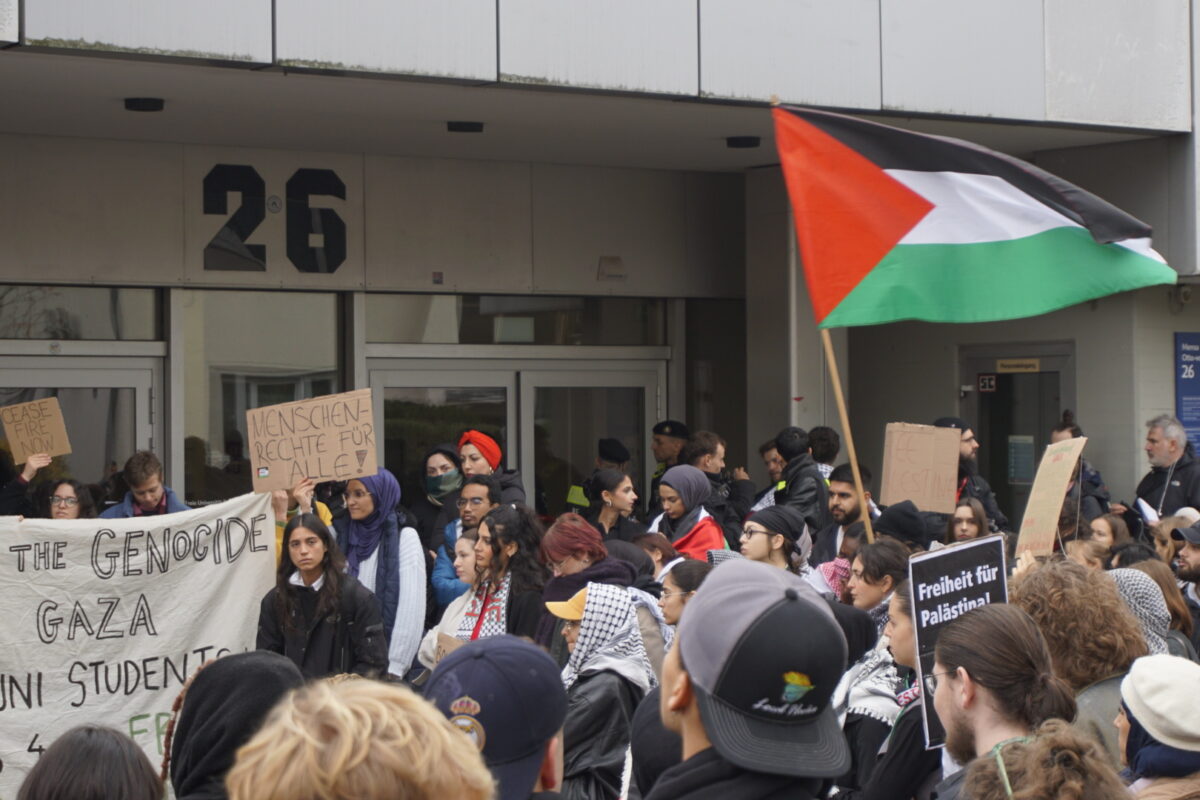
I will proudly be for this cause until we see a free Palestine, but that said, I couldn’t help but be looking over my shoulder at the student demonstration at Mensa II seeing if any of my colleagues were around. When FU sent out an email notifying students of the “mental health checkpoints” around campus because of the Hamas attack on Israel, with no context of the occupation and perpetuating the standard German rhetoric around this issue, I really felt like: “wow, this school isn’t here for me or anyone like me who is witnessing a genocide in front of their eyes and is calling it as such.”

Report 2

I have been frustrated seeing German media claim Jewish students are scared to be on campus as a result of the protests in solidarity with Palestinians. It is especially frustrating seeing German media call these protests antisemitic and “Jew-hating.” I am an international student and an American Jew at the FU. What I have been scared of on university campuses since October 7 is the increasing repression and silencing of anti-Zionist Jewish voices, the huge police presence at campus demonstrations, the possibility of losing my residence permit should I be arrested at protests for being an anti-Zionist Jew in Germany, and the risk of not being able to continue studying here because calling for an end to genocide in Gaza can be seen as an act of antisemitism. After seeing the police arrest Jewish people at the Jewish-led „We Still Need to Talk“ rally on November 10, these fears have increased. 

Scapegoating antisemitism onto students from the Middle East, who have accepted me with open arms and who ensure Jewish voices are heard at protests, is the real fear for me, not the supposed “antisemitism” I have not seen or felt while taking part in these on-campus protests. I am scared of the way police are reacting. I fear repression from the university is only increasing Islamophobia and antisemitism (by pushing the false idea that all “real” Jews are Zionists and Zionism is required to be Jewish). I fear the current German atmosphere, and the willing commitment to defending Israel despite the ongoing crimes against humanity by the Israeli government.

First published in German at Klasse Gegen Klasse. Reproduced with permission

For Solidarity with the Strike at H&M Bangladesh

Why you should join the protest in Neukölln on Friday

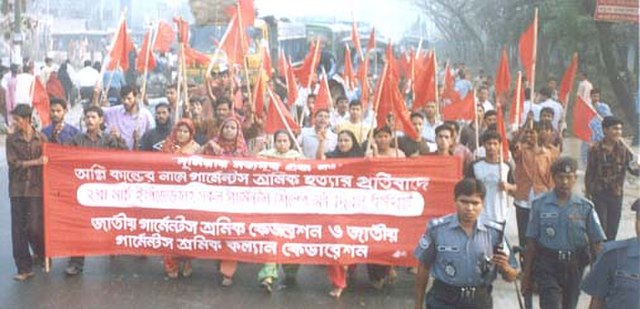
For weeks now the Workers in the Textile Industry have been striking and protesting starvation wages in Bangladesh.

Bangladesh is the home of many of the production facilities for fast fashion brands like H&M, C&A, Zara, and Marks & Spencer. Bangladesh earns annually about $55 billion from exports of garment products, mainly to the United States and Europe, though the workers of Bangladesh don’t benefit from this. Although most fast fashion brands that source from Bangladesh claim to support a living wage, they are only required to pay the workers who make their clothes the legal monthly minimum wage, which is one of the lowest in the world and has until recently remained set at 8,000 taka (66,6€) since 2018.

Trade union negotiations over a new minimum wage for garment workers in Bangladesh have sparked mass demonstrations on streets across the capital. The protests have escalated since the government announced a minimum wage increase for the workers, from 1 December, to 12,500 taka (103,21€), far below the 23,000 taka (189,91€) a month workers say they need to keep their families from starvation.

Factory owners and police have responded to workers’ protests with threats and violence. The beatings a 22 year-old worker named Akhtar received by armed men at Dekko Knitwears left her with a broken arm. “They hit my back, my thighs and my arms repeatedly,” she says. Now, without use of one of her arms, she is unable to work. “I don’t know how I will survive the rest of the month,” she adds.

The only answer against this brutal exploitation and repression of our proletarian brothers and sisters in Bangladesh can be the international solidarity of our class, the working class. That means a general boycott of these companies, and demonstrations to peacefully block the entrances of these stores. We must also have full solidarity with the striking workers in retail stores in Germany, which are now being organized by the German trade union ver.di, and speak with them at the picket line about how their struggle is not isolated, but international in scope. This also goes for the striking locomotive workers in the German railways, who can put pressure on garment supply chains while also fighting for their demands with the GdL trade union.

It is with this message that I decided to spontaneously stand in front of the H&M store on Karl Marx Straße in Berlin Neukölln with a digital sign, calling for “solidarity with the strikers at H&M Bangladesh”. It took less than a half hour and the manager was already coming outside to threaten to call the police if I refused to leave. Mind you, I was standing on a public sidewalk, and despite the manager’s claims, was not on their premises.

We should not bend or not submit to the threats and gaslighting of the H&M corporation. That is why the Berlin left is supporting a protest on 24th November against this exploitation and the censorship of those who try to do something about it. We demand that the GdL, and ver.di trade unions schedule their next strikes for this same day, and for them to add the demands of their fellow workers in Bangladesh for a living wage to their own list of demands for a union contract. Because only with international solidarity can we win against modern day, multinational capitalism.

Join us in protest at 2pm on Friday, 24th of November in front of the H&M at Karl Marx Str 92, 12043 Berlin. To volunteer as an organizer (Ordner) you can email viadrina@linke-sds.org with your Telegram, or Signal number so we can contact you.

Jin, Jiyan, Azadî as in Free Palestine

Statement signed by 250 activists connecting the Woman, Life, Freedom uprising with the struggle for liberation in Palestine.


21/11/2023


We, the undersigned, who have been pleading for Jin Jiyan Azadî in the last year, demand an end to genocide, call for immediate ceasefire, and express our solidarity with the Palestinian people and their liberation struggle.

As we witness genocide being perpetrated by the Israeli state’s occupying forces against Palestinians, overwhelmingly the people of Gaza, as well as the residents of the West Bank, we are filled with anger, pain and devastation. We are deeply troubled by the racist, dehumanising language and hate speech casually broadcast by the Western media, which has complicitly facilitated the ongoing violence. Sitting in unspeakable grief for the countless lives and voices lost during this tragic period, we recognise that mere words and statements cannot restore the lives that we mourn. We firmly believe that the present circumstances demand immediate and urgent action to halt the ongoing genocide and end the systematic oppression of the Palestinian population under settler-colonialism and apartheid.

In addition to expressing our firm support for the Palestinian people in their quest for the fundamental right to “life,” and demand for “freedom,” the purpose of our statement is to extend an invitation to our comrades in the Jin Jiyan Azadî uprising to recognise and connect our struggle to that of the Palestinian resistance in its fight for the right to land, life, and belonging, and as such, a fight for self-determination and bodily autonomy which, as feminists, we must lend our voices and support to.

i) To our Palestinian comrades, we say:

As individuals who have lived in the political geography called “Iran” and under the yoke of the patriarchal and criminal regime of the Islamic Republic, within the broader racist capitalist world order, we know violence in its multifaceted depiction, from its plain to imperceptible forms. We, especially those of us who have been labelled as the “other” and dehumanised by state repression in the Islamic Republic, are acquainted with the ways in which structural state violence renders us disabled. Those of us who have been labelled and dehumanised as the “other” in the diaspora, are familiar with the multiple and intricate forms of state repression and colonialism that govern and violate our existence. As feminists, we know that the struggle for women’s liberation is bound to the collective struggle against capitalism and imperialism, whether we are fighting from Iran, the Global North, or Palestine. We discern you as comrades and companions in our pursuit of “life” and “freedom.”

We believe that just as systems of oppression are intertwined, it is imperative that we link and unite our struggles. There is no liberation that only knows how to say “I” and there is no freedom unless it is for all of us. We have learned the lesson of resistance and solidarity against systems of oppression from those who take to the streets in Palestine under Israeli occupation, our‌ comrades in Afghanistan under Taliban rule, and our Kurdish sisters in Rojava. Generation after generation, we have learned resistance as a daily practice through the Palestinian struggle. We remember fondly that in the early days of the Jina movement, our feminist Palestinian comrades expressed their unwavering support , and recognised the Islamic Republic’s hand in exploiting the Palestinian people’s struggle for freedom. These connections remind us that solidarity is not a one-way or selective path, but a true declaration of “none of us are free until all of us are free”.

We know that the path to collective liberation is not through choosing between false dichotomies such as “global imperialism/Islamic Republic government” or “Israel colonial rule/Hamas reactionary force.” Equally, we recognise the need to avoid the synonimisation of anti-Semitism and pro-Palestine. Instead, it is about dismantling these binaries and oversimplifications altogether. For years, we have been made to believe that our only option is to choose between the “bad and worse.” Today, we say a loud and clear “no” to the false binaries presented to us, and stand against oppression and repression in all its forms. We learn the lessons of “life,” “freedom” and “humanity” from you and your resistance, and we will fight shoulder to shoulder with you until Palestine is free.

ii) To our comrades of the revolutionary Jina uprising, we say:

“Jin, Jiyan, Azadî” was our call to reclaim life through reclaiming our bodies. A roar of anger from our violated and oppressed bodies in pursuit of “life” not as it has been dictated to us. An opportunity for imagining otherwise, continuing the legacy of those freedom fighters who came before us. In the past year, we have been able to reclaim “revolution” from the rotten and patriarchal “revolutionary” discourse of the Islamic Republic. We reclaimed “revolution,” embodied it through the depths of our collective voices and redefined it through our feminist values and desires. Jina, deciphered “revolution”: Jin Jiyan Azadî.

Today, it is our obligation to walk a similar path in relation to the Palestinian struggle and to reclaim it from the discourse of the Islamic Republic. It is our duty to recognise the struggle for Palestinian liberation as part of the feminist and anti-colonial discourse and essence of the Jina uprising. Feminist solidarity and resistance with Palestine does not mean aligning with the constructed narratives of the Islamic Republic, but a rightful and necessary contemplation on the ideals of “freedom” and the fundamental right to “life.” It is a solidarity that, in opposition to the narratives crafted by states, from above, weaves us to the Palestinian people, from below. Let us not forget that the Israeli occupation of Palestine, and the Palestinian struggle for freedom, predates the Islamic Republic’s existence and hold of power in Iran. The Palestinian struggle for freedom neither begins nor is defined by the Islamic Republic. We must reject and free ourselves from the shackles of the Islamic Republic on the one hand, and the nationalist and far-right Iranian forces, especially monarchists in the diaspora, on the other, in relation to Palestine. Let us recognise our intertwined destinies and forge a path towards true transnational feminist solidarity with our dear comrades in Palestine.

We chant Jin Jiyan Azadî – in our thousands, and in our millions – for the freedom of our bodies, desires and destinies, until Palestine is free!

Note: this is a close but not literal translation of our statement in Farsi. This is because we want to acknowledge and speak to the plurality of lived experiences across languages and geographies among feminists in the Jina Revolution. Read the Farsi and translations into Arabic, German and Turkish here.

At the Gallery – Käthe Kollwitz (1867-1945) Spandauer Damm

Kollwitz’s art was for workers


20/11/2023

Whenever I return to Berlin from any long absence, I feel compelled to go to the Neue Wache on ‘Unter Den Linden’, to pay my own small homage to a great artist. There is an enlarged version of Käthe Kollwitz’s original ‘Pieta’ cast in 1937.  A mother holds her dead son, while following Michaelangelo, it remained entirely her own. 

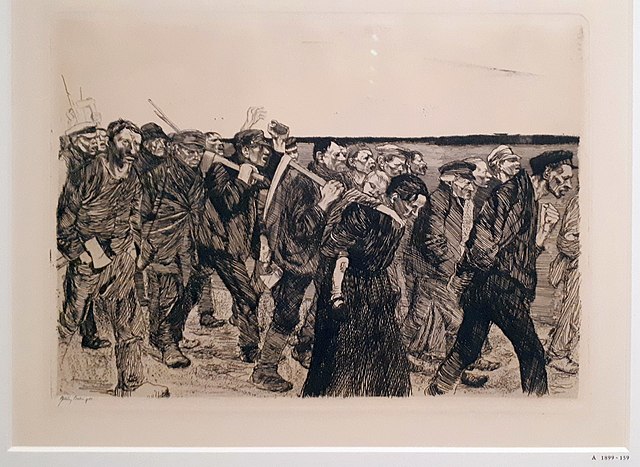
She was a worker’s artist. Her central theme largely became the pointlessness of war, the intense grief of the parents of the fallen soldiers. This theme became ever-larger following the death of her first son, Peter, in World War 1 – only ten days after he volunteered for the front. After the late 1920s this theme became intense and generalized to the ever present ‘Death’ that stalks the working class. 

What sort of an artist was she? I believe she transcends ordinary labels and is not simply a ‘socialist realist’. Because her personalisation of ‘Death’ approximates to Symbolism, and she – as she admitted herself – dwells on the dark side of life. Her meditations such as on ‘the Peasant Wars’ mark her as a socialist realist. A complexity then, reflecting life’s mottled and contradictory nature.

I was newly struck by the theme of ‘death’ when I recently visited the new Kollwitz Gallery. This collection was previously in an old house near Savignyplatz, but has moved to Schloss Charlottenburg, perhaps an incongruous site for this great artist. However, she deserves the enlarged space it will ultimately allow, many works in the catalogue were not shown before.  (‘Kathe Kollwitz”, Zeichnung, Grafik, Plastik”; Martin Fritsch; E.A. Seemann Leipzig 1999). But this new venue also reflects an increasing respect. Previously her work was perhaps side-lined as too “committed” in the West, and too redolent of the GDR where she was an honoured artist. 

The works currently at Charlottenburg are mainly etchings (scratches on a metal plate covered with a wax-like ‘ground’ exposes metal; which being placed into acid become corroded and deeper, allowing them to hold ink); and lithographs (where a special pencil draws a design on a plate which holds onto ink for a print). Although the famous “Turm die Muetter” 1937 bronze of a famous lithograph is also there. Further rooms are in preparation for the vast holdings. 

Undoubtedly Kollwitz identified with the worker’s movement. Her father, Karl Schmidt, actively supported the defeated revolution of 1848. Karl Schmidt never gave up his socialist views, and having supported the 1848 revolution he could not practice law, and became a stone-mason. Her mother was a socialist. A family favorite reading was Freiligrath’s German translation of Thomas Hood‘s poem “The Song of the Shirt.” 

Her brother, Konrad, became an active member of the Communist Party Germany (KPD).  She married Konrad’s socialist friend, Karl Kollwitz – then a medical student. Karl set up practice in a (then) working class Berlin district of Prenzlauer Berg. 

As a child she admired etchings by William Hogarth. Young Käthe drew pictures of the Polish dock-workers in the harbour. Her father got her to The Berlin Academy of Art, the Women’s School in 1884. By 1893, she drew lines with an almost infinite degree of shading from black to white. Later under Ernst Barlach’s influence, she started wood-cuts, achieving stark clarity. Still later she began sculpture. Such were the forms she mastered. But she had long ago found her content – working people. This never changed.

By 1897 she translated Gerhart Hauptmann’s play ‘The Weavers’ into a visual drama of six scenes, depicting the 1844 rising against mill-owners. These led the famous painter Adolph Menzel to nominate her for a Gold Medal at the 1889 Berlin Art Exhibition. She was denied this by Kaiser Wilhelm II because of the class content of her work. In 1901-1908 she created 7 etchings of Wilhelm Zimmermann’s “Allgemeine Geschichte des grossen Bauernkrieges”‚ The Peasant Wars. These are on display in the Charlottenburg gallery currently. 

By 1919 she was made a member of the Prussian academy of Arts and became the first female professor of Art in Germany. 

In her married life, she saw the working class day and night – at their most vulnerable, while they confided in Karl as patients. In all this, she saw beauty in workers. Her aesthetic was different from that of the bourgeoisie:

“But my real motive for choosing my subjects almost exclusively from the life of the workers was that only such subjects gave me in a simple & unqualified way what I felt to be beautiful. For me the Koenigsberg longshoremen had beauty… the broad freedom of movement in the gestures of the common people had beauty. Middle class people had no appeal for me at all. Bourgeois life as a whole seemed to me pedantic… I have never been able to see beauty in the upper class educated person; he’s superficial; he’s not natural or true; he’s not honest, and he’s not human being in every sense of the word.”

“Käthe Kollwitz; „Tagebuchblatter und Briefe [Diary & Letters]”; Ed Hans Kollwitz; Berlin; 1948; p. 43.

But she never considered herself a politically committed “communist”. By 1921 she was writing:

“In the meantime I have been through a revolution, and I am convinced that I am no revolutionist. My childhood dream of dying on the barricades will hardly be fulfilled, because I should hardly mount a barricade now that I know what they are like in reality. And so I know now what an illusion I lived in for so many years. I thought I was a revolutionary and was only an evolutionary. Yes sometimes I do not know whether I am a socialist at all, whether I am not rather a democrat instead.”                                    

June 28th, 1921; “Diary & Letters”; Ibid; p.100

Kollwitz depicted the life of the workers, with its human pleasures – enjoying companionship and children – but she also saw its bitternesses and misery. It is such double-edged tones of Kollwitz’s work that touched some communists. But it is at variance with any ‘simplistic’ notion of any bureaucratically stilted socialist realism.  For it was not necessarily brimming with hope. Likely this was one reason the German KPD criticized her work, and even objected to her doing the Memorial of Karl Liebknecht – which the Liebknecht parents had requested of Kollwitz. Their extraordinary argument was that she was not a member of the KPD. Regrettably, such sectarianism was a characteristic strand in the KPD. Kollwitz recorded her reactions in her diary to this rebuke:

“I simply should have been left alone, in tranquillity. An artist… cannot be expected to unravel these crazily complicated relationships. As an artist I have the right to extract the emotional content out of everything, to let things work upon me and then give them outward form. And so I have the right to portray the working class’s farewell to Liebknecht, and even dedicate it to the workers, without following Liebknecht politically. Or isn’t that so? ” Diary & Letters”; Ibid; p. 98

In contrast to the sectarianism of the KPD are the non-sectarian attitudes of Marx and Engels towards the non-party poet Heinrich Heine whose art they admired and published. Or similarly  Lenin’s views of the non-party writer Tolstoy.

Apart from seeing close-up the misery of working-class life from Karl’s practice, another stimulus to the theme of death was personal. Kollwitz’s two sons Hans and Peter, both volunteered in WW1. Her eldest, Peter, despite father Karl’s beliefs, had illusions about the “concept of death for the Fatherland’ and “sacrifice”.  Some have extrapolated from Kollwitz’s diary that Kathe shared such illusions. (Regina Schulte and Pamela Selwyn; History Workshop Journal, Spring, 1996, No. 41; pp. 193-221). 

If so – she later transformed any prior illusions into condemnation. The cycle of “War’ lithographs between 1920-21 warned youth not to ‘volunteer’ and urged ”Nie wieder!” [Never again!].  

But increasingly her kernel works became more grimly focused. Death was a terroriser and reaper, but at times was a relief. The relief of an old poverty stricken mother who hears the call of death as a friend. Or the desperate relief of the old man who prepares his own noose in the “Last Resort”. This was a recognition of the grim reality of everyday life – and death – of the workers. (Two of her prints-drawings depicting death are at this web-site  http://www.uwrf.edu/history/prints/women/kollwitz.html 

Kollwitz’s personal tragedy was transmuted into art under a slogan from Goethe –

“Saatfruchte sollen nicht vermahlen werden.” [“Seed for the planting must not be ground”].

The “seed”, were the children of course. Perhaps her greatest sculptures are those at the cemetery at Roggevelde Belgium, where her son Peter lay with so many others after the inter-imperialist war of 1914-18. Two figures show herself and her husband Karl grieving. 

It remains true that despite this vortex, she continued to draw for the working class movement. Up to 1928 she drew her famous posters for aid to Russia, and against poverty in Germany. Many were requested by the international “Workers International Relief “.  On 5 February 1933, by now she was the first female director of Graphic Arts at the Prussian Academy, she and Karl took a brave stand against Hitler. Along with 33 prominent co-signators (including Albert Einstein, Henirich Mann and Arnold Zweig) – they endorsed  the “Urgent Call for Unity (Dringender Appell für die Einheit) from the International Sozialistischer Kampfbund (ISK) against the Nazis. Tragically this failed. When the Nazis came to power she was sacked and harassed with Karl. She died in Moritzburg near Dresden on April 22, 1945. 

Yet when she died, she had not given up on a better world. In February 21, 1944 she told her daughter-in-law Ottolie, that:

“Germany’s cities have become rubble heaps… every war already carries within it the war which will answer it. Every war is answered by a new war, until everything is smashed.  The devil only knows what the world, what Germany will look like then. That is why I am whole-heartedly for a radical end to this madness, and why my only hope is in a world socialism… Pacifism simply is not a matter of calmly looking on: it is work, hard work.”

Ibid; p.184

Those words tell us that her concept of socialism was not perhaps, that of a Marxist view. In my view it is of no consequence. Kollwitz defies any single category of ‘Socialist Realist’, and she stands of herself – as a great artist for humanity, and for workers the world over. The Charlottenburg Galleries deserve to be visited by every socialist in Berlin – and those not yet socialists. 

Hari Kumar wrote a more detailed piece on Kollwitz in December 2000 for Alliance Marxist-Leninist. 
Fighting Gentrification is an International Issue

Berlin’s Tech Workers Coalition meets Right2TheCity


19/11/2023

On Saturday, 14.10 the Tech Workers Coalition held a conference open to tech workers across Berlin. A large proportion of the attendees were non-German, and there was a strong thematic emphasis on the importance of transnational organizing in labor as well as in housing.

Right to the City – the English speaking working group of the Deutsche Wohnen & Co. Enteignen campaign – was invited to facilitate a workshop meant to build coalitions between migrants in Berlin’s tech industry and tenant organizers.

Naturally, the two groups overlap: R2C was formed early on in the DWE campaign when it became clear that migrant tenants faced particular forms of exploitation as renters. They are often on newer contracts, and landlords routinely take advantage of their non-Germanness – charging them well above market rates and getting away with other illegal tactics. Because migrants often do not have the same level of German and lack both networks and resources, they are less able to challenge these conditions or to be aware of their systemic nature. 

This trend has a ripple effect, impacting every renter in the city. Whereas narratives abound that migrants are the gentrifiers, the workshop participants – which included non-Germans and Germans – had critical discussions about these stories. The outcome was that together they challenged the simplistic myth that migrants are the driving force of gentrification in Berlin rather than often being caught up in its effects themselves. Instead, the groups highlighted the parasitic role of the rentier class and financialization of the housing market as the underlying forces driving the housing crisis in Berlin.

Other topics discussed in the workshop included that the referendum campaign was in part stymied due to the fact that non-German citizens can’t vote. This is an important issue because it also sheds light on Germany’s democratic deficit. As it stands, nearly 25% of the city’s population holds non-German passports and therefore cannot participate in the referendum. In the workshop, participants asked what the point of R2C’s involvement in the campaign is, and we (R2C) discussed how we still have the capacity to achieve a successful outcome by organizing and by shedding light on the issue of our disenfranchisement. In fact, the latter is something that R2C has already helped bring across the German media since the formation of our working group. 

While some doubts may have arisen during the workshop, such questions also presented an opportunity for us to emphasize the agency that migrants have to shape the referendum result. We discussed strategies for coalition-building between labor and tenant organizers, whilst participants thought of ways to bring Enteignen conversations into their workplaces. Also discussed was the role of works councils – not only for negotiating rights at the office, but for encouraging involvement in DWE as well.

Ultimately, the workshop generated a lot of interest in the capacities of tech workers to use their unique skills to expand tenant rights and participate in the DWE Enteignen campaign. Tech workers are already armed with coding knowledge, data analytics skills, the capacity to provide multilingual translations. All of which are now being mobilized towards furthering current R2C initiatives, as a number of workshop participants have signed up to get involved in our org.

The sentiment at the end of this workshop was hopeful, and we’ve already seen familiar faces at R2C meetings since then. The antidote to the scourge of gentrification, labor exploitation, and discrimination against migrants is building solidarity across differences, shedding light on these concerns, and doing whatever we can to be consciously engaged in shaping the city in line with the will of everyday people who live here. These themes were prevalent throughout the broader TWC conference as well – again shedding light on the interrelatedness between tenant and labor rights.