The Left Berlin News & Comment

This is the archive template

Artists and Musicians in Germany Speak Out Against Genocide of Palestinians

In spite of repression, solidarity with Palestinians is growing in Germany

German-language media in Berlin, from the Berliner Zeitung to the supposedly left-leaning newspaper taz, have been united in their call for for artists and clubs to show support for Israel and the Israeli government in its ongoing genocide of Palestinians in Gaza. The Berliner Zeitung wrote on 12 October 2023, “AfD and A100, they are clear opponents, but Hamas is not? Why does it seem so difficult right now to mobilize forces of solidarity in Berlin’s techno scene?”

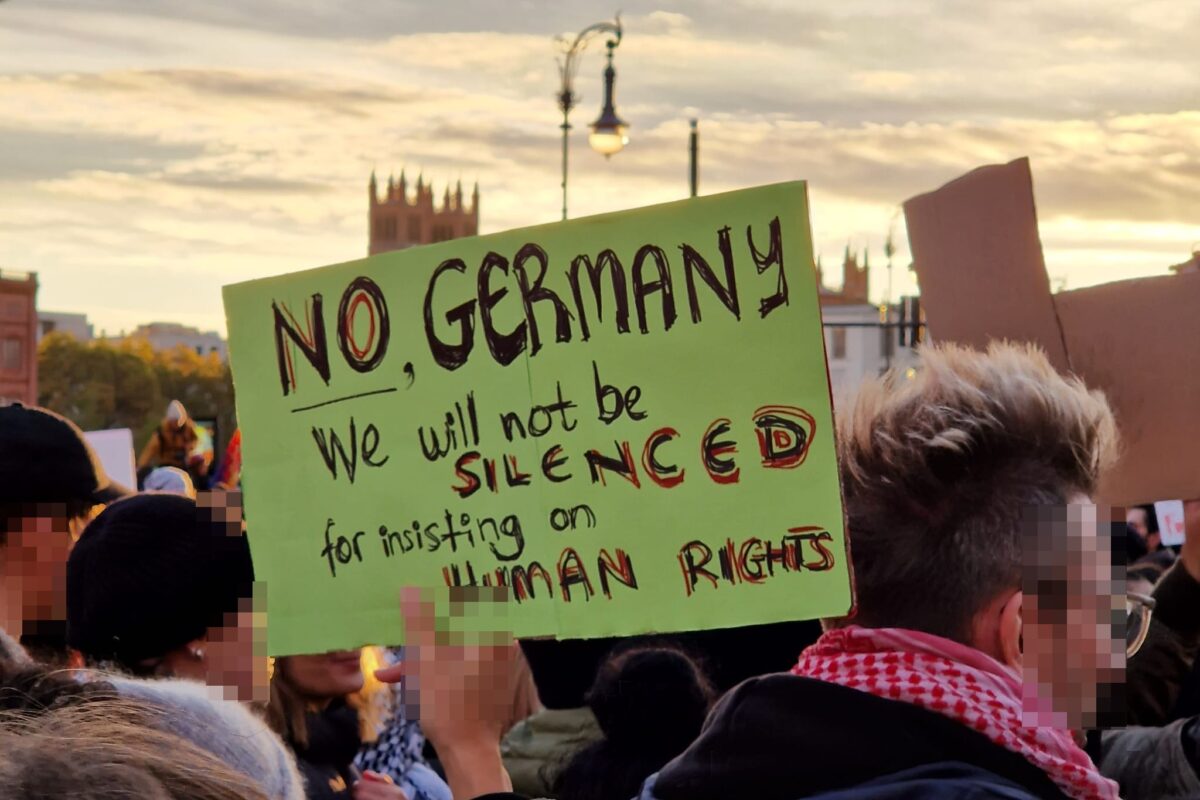
Despite the lack of solidarity or sympathy for Palestinians in Gaza in the German media, artists and musicians in Germany have been speaking out against the ongoing genocide of Palestinians by the Israeli state. They have also spoken out, more generally, against the occupation of Palestine, the support of the state of Israel by Germany, Canada, the United States, Britain, and other white-majority countries, the violence of checkpoints, and the 16-year-long blockade that has made the Gaza Strip an open-air prison. By choosing to show solidarity with Palestinians, artists in Germany who are not Palestinian risk threats, arrest, and loss of income and opportunities. Artists who are Palestinian simply have had no choice: they have faced repression in Germany their whole lives.

To understand how speaking out has been affecting artists, we at the Antifascist Music Alliance asked those artists to report to us any gigs lost due to posting about Palestine on social media. As Israel bombed Gaza in the first weeks after October 7, most of the artists who spoke out against the indiscriminate murder of Palestinians were Black people and people of colour. Even though white artists have also spoken up, Black artists and artists of colour have been the most affected by cancelled gigs. Such a discrepency can serve as a reminder for white artists to use their privilege in this moment to turn the tides of support in Germany.

Pinkwashing and the German media

You have probably read the term “pinkwashing” in connection with the state of Israel. “Pinkwashing” is an effort by the Israeli state public relations initiative “Brand Israel” to portray Israel as especially welcoming to queer people. “Brand Israel” launched in 2005 after a three-year consultation with American marketing executives, to rebrand Israel as “relevant and modern, instead of militaristic and religious,” as Sarah Schulman lays out in Brand Israel and Pinkwashing: A Documentary Guide, an appendix to her book Israel/Palestine and the Queer International. “Brand Israel” thus makes use of anti-Muslim hate and racism amongst Israel’s supporters to portray Palestinians as homophobic. In Queer Palestine and the Empire of Critique, Sa’ed Atshan clarifies:

Pinkwashing is defined as a discourse on Israeli LGBTQ rights aimed at detracting attention from violations of Palestinian human rights. […] The dynamic that this term signifies is as follows: rather than improve its global standing by providing Palestinians with basic human rights, the Israeli state and its supporters, increasingly moving to the right, seek to market Israel as a state that supports LGBTQ individuals and communities.

In an article in the Berliner Zeitung (BZ), a Berlin-based Black trans DJ mentioned that they had posted an Instagram story about a “police-banned, anti-Israel ‘Demo in Solidarity with Palestine’ on Neukölln’s Richardplatz.” The BZ reported, “police feared anti-Semitic exclamations, glorification of violence as well as violence.” The reporter then added that the DJ is “queer and trans themselves. Hamas would certainly disagree with this way of life. But there seems to be this certain tendency in the club world, even among people who themselves belong to minorities, to feel solidarity with the Palestinians without any ifs and buts – and to label Israel simply as a perpetrator and colonialist aggressor.”

Queer Palestinian-American @officialjakegyllenhalal published a video response to the argument, “You would be ____ed in Palestine as a (rainbow flag emoji) person.” In it, she says, “Homophobia, transphobia and misogyny unfortunately exist in all parts of the world and just because it can happen in Palestine […] does not mean that Palestinians don’t deserve to exist because of it.” She clarifies a few reasons why this idea is so harmful: for one, it denies the diverse existence of Palestinian people. There are of course many queer and trans Palestinians. She adds that the “attempt to homogenize [Palestinians] is a dehumanization strategy in and of itself,” and it takes away the right of Palestinians to be flawed. Palestinian individuals’ shortcomings must not be used to to garnish support for their Israeli-backed genocide. When someone repeats the idea that queer people would be sure to experience violence in Palestine, those imagined acts of violence came from somewhere. The person imagining this violence, like the Berliner Zeitung reporter, “absorbed that information as truth from a heavily funded, 75-year-long misinformation campaign that is working very hard to dehumanize [Palestinians] to justify [their] genocide.” @officialjakegyllenhalal also makes it clear that saviourism is completely unwelcome; whatever queer Palestinians are facing in their own communities in terms of homophobia, transphobia or misogyny, it is their own battle to fight. Queer Palestinians will certainly not be turning to their oppressors for help, the same people who are “massacring [their] families, demolishing [their] homes, ethnic cleansing [their] people, and taking [their] land – queer or not.”

As leftist people in Berlin reflect on their solidarities, at a time when the German state and media attempt to sanitize the genocide of Palestinians by describing a war on Hamas, this evergreen 2012 quote from Sarah Schulman might be helpful. Schulman grappled with her own failure to “get it” – she was progressive except for Palestine. She writes,

“I have been in antiwar demonstrations with Catholics who actively fight against abortion rights, which I consider to be essential to female autonomy. So the only reason that sharing a common outrage with Hamas at the killings in Gaza disturbed me more than all the other religious fundamentalists I had had some moment of common ground with in the past was my own prejudice. Once that conceptual gap was faced, I examined the specifics. Hamas was democratically elected. It doesn’t matter what I think about Hamas. What matters is that my country, the United States of America, is providing military aid to Israel, who in my name is committing war crimes. So, consistent with my lifetime of work for justice, my responsibility regarding Israel is to speak out against what is being done in my name with my tax money. Period. It’s not always so clean, these decisions, but they still need to be faced.”

(Israel/Palestine and the Queer International, pg. 19)

One way to express your support for queer people in Palestine is to read and share the open letter from the group Queers in Palestine. The statement calls for a refusal of “the instrumentalization of our queerness, our bodies, and the violence we face as queer people to demonize and dehumanize our communities, especially in service of imperial and genocidal acts.”

Open letter to gay nightclub SchwuZ after censorship of Palestinian and pro-Palestinian queers

For an example of what pinkwashing has accomplished locally in Berlin, we can look at two incidents of repression at the gay nightclub SchwuZ. A group called Drag for Palestine wrote an open letter to SchwuZ after an event called “Drag Open Stage Finale” on 13 October 2023. That night, a German-Palestinian attendee with family in Gaza was asked to turn his shirt inside-out. The shirt read, “Anti-Apartheid Club.” At the same event, a drag performer brought a banner on stage that read, “Free Palestine/It is not a conflict, it is settler colonialism against which resistance is justified,” after which the performer was asked not to bring the banner on stage again. SchwuZ staff told the performer that the drag event was, “not about a political agenda,” and that, “it is not possible to show the complexity of the situation in a banner.”

As a response, the open letter was published. They are still collecting signatures and publishing comments from signatories on their Instagram account. The authors highlight in the open letter that, “Queer liberation and liberation from any form of oppression must go hand in hand. Drag is an inherently political art form […] Just as anti-colonial, anti-racist, and anti-imperialist expressions are part of drag, the solidarity with Palestinian liberation has its representation in this art form.” (Drag them!) Drag for Palestine takes a strong stance against the genocide of Palestinians in Gaza, for which the Antifascist Music Alliance would like to thank the authors. The letter includes a few easy-to-fulfill requests: that SchwuZ not censor Palestinian or pro-Palestinian voices in the future, and that SchwuZ issue a public apology for their acts of intimidation, and express solidarity and support for Palestine and against the apartheid. The authors call for a boycott of SchwuZ as performers or visitors until they show accountability.

Munich club Blitz cancels night after Palestinian solidarity posts

The nightclub Blitz in Munich cancelled a night called VAPOR on 27 October 2023, which was meant to feature artists JASSS, Blawan, LCY, and Lydo. LCY is a UK-based artist who had posted in support of the Palestinian people in the days leading up to the party. As they were about to board their plane to Munich, they were told that Blitz’s club owners did not want them to play because of their posts on Palestine. Blitz then cancelled the night entirely.

In response, LCY wrote in an Instagram post: “I am anti-fascist/pro-equality and in my lifetime would never ever stand to see ANY humans displaced, tortured, murdered and vilified just as what is happening to the Palestinian people. I stand against that.” They added, “It is a shitty situation to lose work and was reluctant to share because I never want anyone to be in fear to voice their opinions on a subject like this […] I’m not the only artist that has been pulled from gigs and there are people being fired all over the country for sharing their opinions – we need to be a unified voice against the genocide or it is easier to pick at the individual.” LCY showed great courage in the face of repression.

Afterward, Blitz made a post on Instagram, saying that it cancelled the event because an artist posted a video on social media recommending the “dissolution of Israel.” The video LCY had reposted was a video made by another person. What Blitz failed to mention is that the video went on to say, “Israel must be dissolved and go back to being called Palestine—a home for Muslims, Jews, Christians.” This statement is not anti-Semitic at all and was taken out of context by Blitz in a way that the club knew would incense their pro-Israel German audience. Later, Blitz deleted their post after many people wrote to ask them to take down this misquote. Blitz apologized for “any harm caused” in a now-gone Instagram story, and they called for an “immediate ceasefire to stop the killing of innocent lives.” Blitz still felt it was necessary to add that they, “profoundly disagree with the idea of dissolving the state of Israel as the only possible chance for co-existence.” It is because of the courageousness of LCY that Blitz backtracked their statement that was so harmful to Palestinians, but a lot of damage was done, including in an article by large-circulation newspaper Süddeutsche Zeitung, which criticizes Blitz for failing to call the video anti-Semitic in their apology story.

HÖR Berlin censors artists’ pro-Palestine clothing

For many artists, getting a mix on local streaming platform, HÖR, has been a career goal for gaining visibility and traction. However, over the last weeks, at least two artists came forward to say that HÖR asked them to stop playing or remove clothing that was in support of the Palestinian people. Several artists are calling for artists to boycott HÖR and remove their mixes from the platform in solidarity.  HÖR, whose owners are Israeli, issued a statement by email to artists who have performed for them in the past. In it, HÖR made it clear that they do not understand Palestine to be occupied land that Palestinians should be able to live on. One censored artist wore a shirt that included a map of present-day occupied Palestine. In their email, HÖR called this shirt, “offensive,” and wrote that it was calling for the eradication of Israel. Confusingly, they also wrote that, “We believe in freedom of expression, and we have not, and will not, censor flags or peaceful slogans” and that “our platform will remain open to anyone looking for an outlet to express themselves via music.”

With respect to the use of the map of pre-occupation Palestine, Ijeoma Oluo said it well in an Instagram post: “The idea that Palestinian liberation would require the mass k*ling of Jewish people is so fucking racist and it boggles the mind how many so-called progressives believe it […] If your safety requires the occupation, imprisonment, and oppression of a people: you don’t have safety and you never will.”

Bored Lord is one artist who called for the removal of her DJ set from the platform in solidarity. About her support of the censored artists, she wrote: “i didnt remove my set from hör as some ‘trendy cancel culture’ thing. i did it bc i don’t want zionists profiting off my free labor. and i dont care about the mix i made. it’s a very small price for solidarity. last waste of breath I’ll spend on this topic. invest in diy radio culture. and free Palestine.” The Antifascist Music Alliance support Bored Lord and other artists calling for a boycott of HÖR wholeheartedly. Other artists who wish to contact HÖR or ask for their mixes to be removed may reach them at booking@hoer.live

Yes… we have something to say about ://about blank

Anti-Deutsch Berlin club ://about blank made a statement via Instagram on 12 October titled, “the horror won’t go away, the nightmare won’t end.” Their statement is a clear example of Jewish trauma and Germany’s white guilt being misused and weaponized against the Palestinian people. This frame is specifically pushed by the Israeli government to justify their ongoing genocide of Palestinian people.

://about blank directly links the horrors of the Holocaust to the Israeli people who were killed on 7 October calling it, “the biggest mass murder of Jews since the end of nazi extermination camps in 1945,” as if these situations are the same. Their statement removes all context: an act of desperation of an oppressed people against an fascist apartheid state is not comparable to Germans’ own (still deeply rooted) antisemitism. The outrageous part is that this framework is so effective in Germany and elsewhere. With this racist approach, German white guilt and fear of being called a Nazi are instantly activated. At the same time, Germans’ superiority complex is activated, because they think they are heroes by criminalizing everyone who opposes the genocide of Palestinians. In this context, ://about blank can propagate their Islamophobia (using phrases like “the islamists of hamas”) and actively support Israel’s genocide.

In the statement there is a heavy emphasis on Islamic and Jewish identity. This is an attempt to justify Israel’s violent colonialism as if it were a religious conflict. To be clear: this is and has always been about stealing land and erasing its indigenous inhabitants. ://about blank ignores completely the many thousands of Jewish people worldwide who have been non-stop protesting the violence of Israel. Not, “Never again to my people,” but, “Never again to ANY people.”

Reclaim Club Culture reposted the statement from ://about blank on their Instagram. Reclaim Club Culture is probably best known for their street rave “A100 weg bassen!” and their organising against the A100 highway that is planned to flatten a good chunk of the Ostkreuz area so it can only be used by cars. They have close ties to ://about blank, having hosted events there in the past. It’s disappointing to see an ostensibly leftist group repost the statement from ://about blank, which speaks over leftist Jewish groups in Berlin like the Jewish Bund, which are calling for solidarity with the Palestinian people and an end to the genocide in Gaza.

Heartening solidarity with Palestine from platforms, venues, and artists in Berlin

Despite all the repression from the music scene and from the German government and media, there have been many encouraging statements of solidarity and actions in Berlin.

Refuge Worldwide is a local radio station that honoured the call for a global strike on 20 October by going offline for 24 hours and making a clear statement calling for an end to the genocide and the occupation. They drew attention to police brutality in Berlin, writing that, “Basic human rights in our home of Berlin are under threat, we are witnessing police brutality on the streets of Neukölln. People must be able to speak out and grieve, and the right to demonstrate must be protected.” They also shared resources and linked to Radio Alhara, a radio station in Palestine’s West Bank, and to Jewish Currents, an anti-occupation Jewish Left magazine.

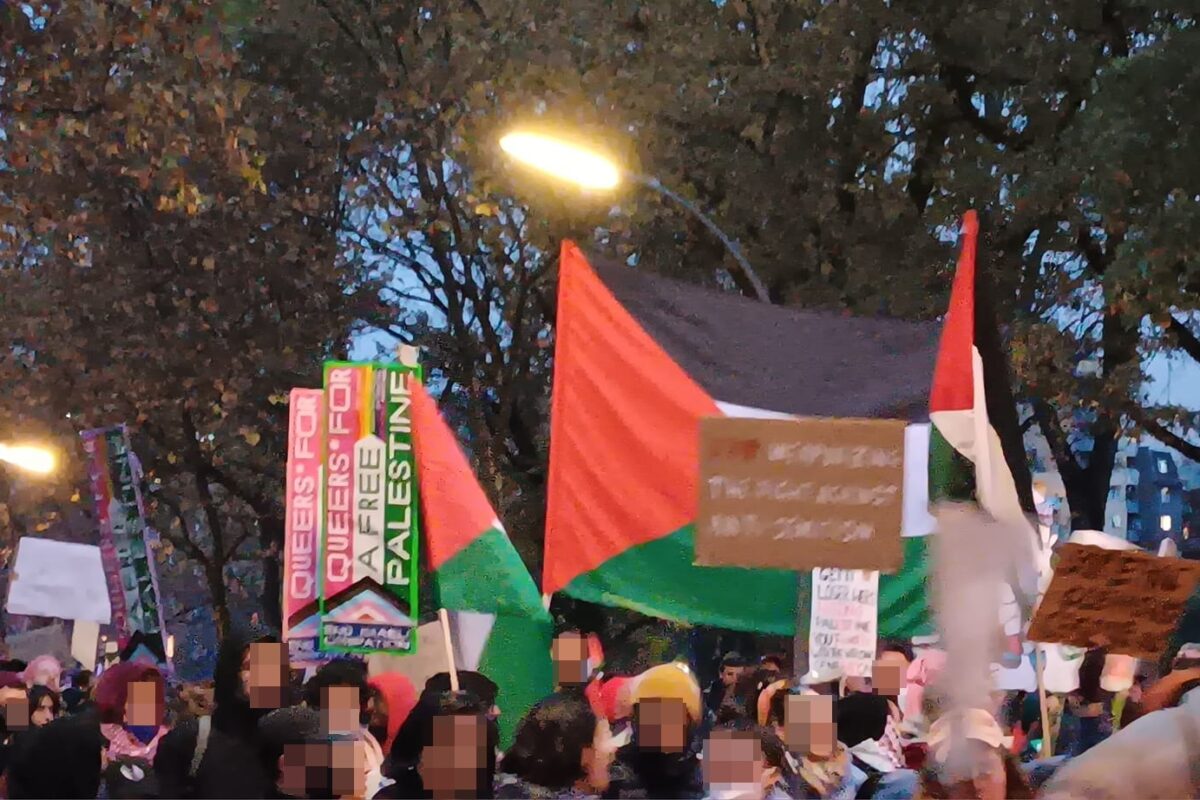
A new collective of Berlin-based artists and workers called AATMA (Antifascist Art Techno and Music Alliance) was announced on 25 October, with a public statement and call for action in solidarity with the Palestinian people. In their first Instagram post, they “condemn the dehumanisation of Palestinian lives by the Israeli and German state and media,” noting that, “in the past weeks, state and city officials have banned the Palestinian flag, the kafiyyeh, as well as all statements, public gatherings and demonstrations that express solidarity with Palestine.” In the open letter, they draw the connection between artists/art workers with Palestine solidarity, writing that, “We believe that clubs and cultural spaces can play an important political role in refusing the illegal crackdown on the right to freedom of assembly and the debasing practices of media policing,” and call for, “music and cultural venues to offer their spaces for congregation while it is unsafe for us to gather in public.” They added, “We regard music venues and cultural spaces as important places of techno-political assembly that have historically played substantial roles in resisting fascism.”

Trauma Bar is a Berlin music venue that made a public statement on 1 November. In it, Trauma Bar wrote that they, “condemn the ongoing retaliatory actions by Israeli forces, characterised by indiscriminate bombings and a blockade of essential supplies such as water, electricity, and fuel to Gaza.” They also linked to an Amnesty International petition calling for ceasefire, and called for donations to the European Legal Support Center, which is a great place to donate now that most aid is not reaching Palestine.

Passive voice and silence is violence
Berghain only broken its apolitical silence once to post about anything other than its no-photo policy when they expressed solidarity with Ukrainians in March 2022. Their website still says, “Stop the War!” It would be nice to see a call from Berghain to stop this war with a ceasefire and an end to occupation, but don’t hold your breath.

Another not entirely silent yet comparatively violent aproach can be witnessed by CTM Festival’s use of passive voice for Israel’s actions in their statement on instagram. CTM launched a section on their website that specifically shares ideas on how to help and “Stand with Ukraine and Stop War!”. However, after 7 October the festival’s positioning reads at best like a “both sides” narrative. The focus of the aggression is put on Hamas through use of active voice, without mentioning Israel and the ongoing genocide with a vastly disproportionate number of civilian victims. CTM instead focuses on the cutting off of water and electricity as a humanitarian crisis. All of it without mentioning Israel as an actor holding a blockade on resources and their targeted bombing of  civilians, hospitals and schools. After four weeks of this initial statement there has been no follow-up.

DJ & producer Bjarki calls on other artists to use their privilege
Bjarki is an Icelandic DJ and producer in Berlin, who has been using his platform to speak out in solidarity with the Palestinian people. In an interview with the Antifascist Music Alliance, Bjarki noted that since starting to speak out about Palestine in 2020, many people discouraged him. He said, “I’ve been advised by industry contacts and acquaintances not to discuss this topic publicly. The conversations around this issue are often heated, and there seems to be an effort to dissuade me from speaking out. I believe it’s my duty as a human being and as a musician who stands by connecting with people through music, which speaks a universal language of awakening, love, understanding, and togetherness to speak out freely.” From German clubs and promoters, Bjarki said that he hasn’t received a lot of backlash directly, but he did say that, “promoters are trying to silence people.”

When he first decided to speak out by posting information he thought was important, some people began writing to him to contradict the content of his posts, and he realized he needed to further educate himself. At that critical point, his grandmother in Iceland recommended him Hjálmtýr Heiðdal’s book Iceland Street in Jerusalem. The book is an in-depth history of Iceland’s role in the founding of the Israeli state. His grandmother explained that the issue was simple, but profound: it’s about colonialism.

In a statement shared with the Antifascist Music Alliance, Bjarki issues a call to other privileged artists:

To artists who aren’t touched by the fires of injustice, remember, your comfort is not a shield to hide behind, but a platform from which to lift others. […] We’re not just here to create art; we’re here to stir the souls and awaken the minds of the world.

Call for action

As the Antifascist Music Alliance, we call for an end to the occupation, an end to apartheid, and for an immediate ceasefire.

If you are looking for a page where you can publish your letter, essay, poetry, etc. in support of and solidarity with oppressed peoples, we are offering our Antifascist Music Alliance website. Our main focus right now is Falastiin, Sudan, Congo, and Haiti. We published a poem by Edel Ahmed recently. We especially encourage people who are doing a call to action, such as letters addressing institutions that are silencing people and institutions that are silent. this includes nightclubs, art spaces, radio stations, etc. to reach out to us.

Honour Boycott Divestment Sanctions
The 3 demands of the BDS movement are: 1. Ending Israeli occupation and colonization of all Arab lands and dismantling the Wall, 2. Recognising the fundamental rights of the Arab-Palestinian citizens of Israel to full equality, 3. Respecting, protecting and promoting the rights of Palestinian refugees to return to their homes and properties as stipulated in UN Resolution 194.

Donate to European Legal Support Center
ELSC is “keeping track of incidents of repression against Palestine advocacy in the EU and the UK” –  – this is a great place to donate within Europe

Share the open letter of Queers in Palestine

Report incidents to 7amleh, the Palestinian Observatory of Digital Rights Violations

This organization collects incident reports of fake news, hate speech, incitement, smear campaigns, hacking, gender-based violence, arrest, and censorship:

Read some books

  • Israel/ Palestine and the Queer International by Sarah Schulman, Duke University Press (2012)
  • Queer Palestine and the Empire of Critique by Dr. Sa’ed Atshan, Stanford University Press (2020)
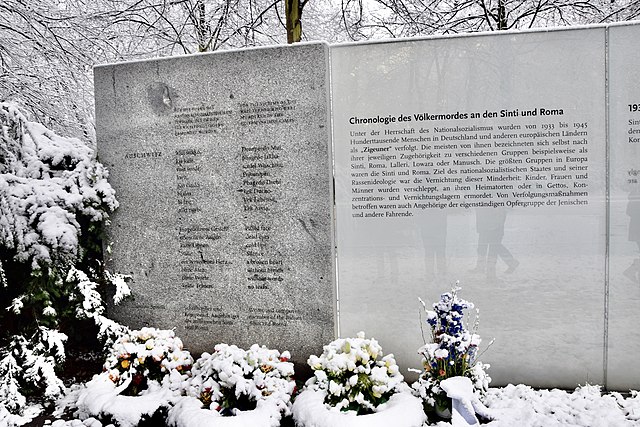
Save the Berlin Memorial to the murdered Roma and Sinti of Europe!

Open Letter to Berlin’s Senators for Culture and Transport


01/12/2023

To:
Joe Chialo, Berlin Senator for Culture and Community
Manja Schreiner, Berlin Senator for Mobility, Transport, Climate Protection and the Environment

The memorial to the Sinti and Roma of Europe murdered under National Socialism in Berlin is in imminent danger. Deutsche Bahn is putting pressure on the Berlin Senate to approve a new S-Bahn line directly under the memorial.

For the so-called S21, old trees on a large scale would have to give way, which are central to Dani Karavan’s artistic vision. Without these trees, the unique atmosphere and tranquility of the memorial site between the Reichstag building and the Brandenburg Gate would be permanently destroyed.

For the Sinti and Roma minority, the memorial is a sensitive place of remembrance of the victims’ suffering and their own loss – a symbolic grave.

“My father, my mother, my sisters and my little brother were murdered in Nazi extermination camps and have no grave where I could go and lay flowers. A place where I can stand still and be with them in my thoughts. That is a great loss. I considered this memorial to be my family’s grave. […] I call on those who are planning the route of the new S-Bahn to take into account the wishes of the Sinti and Roma community in Germany and beyond. The only good solution is an alternative route so that our monument is not damaged and peace is guaranteed. […] Leave our monument untouched so that our dead may find their eternal rest.”

Thus spoke Zoni Weisz in 2021, who as a child survived the genocide of the Sinti and Roma in the Netherlands and lost his entire family.

With the memorial, the Federal Republic of Germany symbolically acknowledges its responsibility for the crimes committed against the Sinti and Roma. Its erection in the heart of Berlin is a centerpiece of historical and political responsibility in the present, in Germany as well as in Europe, a memorial against forgetting. The genocide was only recognized in the Federal Republic of Germany in 1982, and it took thirty more years of political struggle before the memorial could be inaugurated in 2012 – 67 years after the end of the Second World War and 20 years after the first declaration of intent by the federal government to erect such a memorial.

In the summer of 2020, the public and the members of the Sinti and Roma minority learned through the press about the planned construction of the S21 suburban railway line and the associated encroachment on the memorial.

After numerous protests and negotiations, the “variant 12h” was finally presented as a “compromise proposal”. But this too entails the felling of a large part of the surrounding trees and thus the destruction of the overall work of art. Israeli architect Dani Karavan, creator of the memorial, said before his death in May 2021:

“The trees are an integral part of the memorial and a crucial element of the atmosphere I wanted to create. If the trees are altered in any way, the clearing will lose its features and the unique atmosphere of the memorial will be damaged. Any change to the trees would destroy the memorial’s seclusion from the city and drastically affect its function as a place for contemplation and meditation.“

The Foundation Memorial to the Murdered Jews of Europe, which is also responsible for the Memorial to the Sinti and Roma of Europe Murdered under National Socialism, states that with “variant 12h” it would no longer be able to ensure its legal mandate, the remembrance of the murdered Sinti and Roma of Europe and their appreciation, in a suitable manner.

The Berlin government now wants to press ahead with the construction plans. With only a week’s notice, representatives of Sinti and Roma NGOs, Noa Karavan, daughter of Dani Karavan, and the Monument Foundation were invited to a meeting on 28 September. By 13 October, “concrete proposals for improvements to the present proposal (construction variant 12h)” are to be submitted. The Berlin Senate’s goal is a “rapid commitment to variant 12h in order to avoid ongoing costs and estimated construction cost increases in the millions”. Alternative routes that would leave the memorial to the Sinti and Roma untouched are no longer being considered for cost reasons.

Are we allowing the interests of Deutsche Bahn, legal successor to the Deutsche Reichsbahn, which transported the victims to the concentration and extermination camps, to destroy the memory of the dead?

We the undersigned and the majority of the Sinti and Roma reject the proposal!

It irrevocably destroys the memorial to the murdered Sinti and Roma of Europe.

It dishonors the victims, the survivors and their descendants.

It fundamentally attacks the commitment of German society to the memory of past crimes.

It is not the task of the affected minority to look for alternative solutions for variant 12h, but the moral and political obligation of all Germans to stand up for the integrity of the monument.

We call on the Berlin Senate not to take any further steps until a route is found that leaves the monument untouched in its entirety.

First signatories:

  • Hava Karavan, Wife of Dani Karavan
  • Noa Karavan-Cohen, Daughter of Dani Karavan
  • Tamar Karavan, Daughter of Dani Karavan
  • Yael Karavan, Daughter of Dani Karavan
  • Hamze Bytyçi, Chairman of RomaTrial e.V.
  • Romeo Franz, Member of the European Parliament
  • Uwe Neumärker, Director of the Foundation Memorial to the Murdered Jews of Europe
  • Alexandra Senfft, Writer
  • Daniel Strauß, Director of RomnoKher

This is a republication of the letter. You can see the original and the full list of signatories here.

Robert Habeck wrote a play praising a right-wing mass murderer

Fifteen years ago, Germany’s Green vice chancellor wrote a play in which the hero is a right-wing mass murderer


30/11/2023

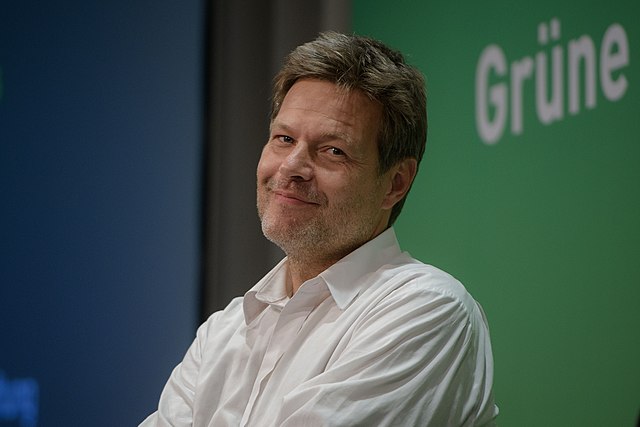
Robert Habeck cuts a noble and tragic figure. The Green vice chancellor, with his three-day beard, open collar, and permanently disheveled look, strikes many as a former idealist who has been forced to abandon his principles. Deborah Feldman, an American Jewish immigrant, recently wrote that Habeck once seemed like »the little guy, one of us, a dreamer and a storyteller, someone who went into politics because he thought he could change it.« What a disappointment! Yet what did Habeck used to dream about?

Fifteen years ago, Habeck and his partner wrote a play called Neunzehnhundertachtzehn (»Nineteen Eighteen«) for the 90th anniversary of the German Revolution, which began in his home town of Kiel. The hero of the play is a Social Democratic fixer named Gustav Noske.

Every biography says more about the author than the subject – it’s a book length reflection about what constitutes a good life. Long before throwing his hat into the national political ring, Habeck told us how he thought a responsible politician should act. This insight was worth far more than the ten Euros I paid for a used copy of the play.

If you’ve ever heard of Gustav Noske, it’s because he gave the order to assassinate Rosa Luxemburg and Karl Liebknecht. But this was no isolated murder. As war minister in the counterrevolutionary government of Friedrich Ebert, Noske commanded far-right paramilitaries who massacred 2.000 men, women and children in March 1919 in Berlin. He referred to himself as a »bloodhound«. The first time a German city was bombed from above? That was Noske’s proto-fascist troops using airplanes to attack the working-class neighborhood of Lichtenberg.

Habeck could have written about anyone. But he needed to tell us that Noske was actually a pretty cool guy.

The play takes place in early November 1918, two months before Noske’s career as a bloodhound begins. A revolution has just broken out in Kiel and the government needs an agent to keep things under control. As an experienced politician, Noske runs circles around the insurrectionary workers and sailors who are trying to build a new system. He proudly lies and manipulates everyone in order to keep the old system in place.

Beyond Noske, the play has little to do with the historical record. The actual head of the Workers’ and Soldiers’ Council in Kiel, for example, was a sailor named Karl Artelt. He had organized strikes at the Kiel shipyard, and remained a committed socialist until his death in 1981. Habeck chose to replace Artelt with a young worker named Fritz, a hothead whose main revolutionary activity consists of stabbing officers with his bare hands. He claims to carry out executions »in the name of the soldiers’ council«, but in practice Fritz rejects any kind of democracy. In reality, the revolution in Kiel involved very little killing and certainly none by Artelt.

Habeck has Noske save the day, bursting into rooms like the Kool-Aid Man to stop »bloodshed« – even though Noske was by far the most bloodthirsty figure of the German Revolution. At one point, Fritz asks Noske why he wants to preserve the old order, even though he’s nominally a socialist. Habeck has his hero explain: »Because people don’t care about justice. All they care about is getting fed, being warm, being left alone. They want orderly conditions, not justice. That’s what social democracy stands for. The struggle is not for the people. The people are a sluggish, stupid, and ultimately dangerous mass. The struggle is against the people to enforce what is best for the people«.

Here is Habeck’s famed idealism! The Green Party of today is quite similar to the SPD of a century ago in their deep distrust of the »mob« and any kind of democracy.

But what about principles? Again, Habeck lets Noske elaborate: »If you take on responsibility, it changes your personality. You do things that you would have categorically rejected before … I was always against war. But if you have responsibility and someone says, if you don’t vote for this, then our soldiers won’t get gas masks and they’ll die in the next attack, then you suddenly raise the military budget, without even wanting to«.

This is yet another historical inaccuracy. Noske was never a principled antimilitarist, like the majority of the SPD at the time, but rather a voice on the party’s right wing supporting colonialism.

Over the course of the revolution, Noske was successful in maintaining »order«. He did this by arming right-wing paramilitaries to the teeth and giving them free rein to murder some 15.000 people. These Freikorps would soon organize themselves in the NSDAP and take power themselves. The Nazis acknowledged the help they had gotten from Noske: Hitler referred to him as »oak among these social democratic plants«. Even after the war, when he wrote his memoirs in 1946, this murderer of countless Jewish revolutionaries continued to make disparaging remarks against »Ostjuden« (Eastern Jews).

Years before he had any real responsibility, Habeck was telling us that principles are only there to be betrayed once you gain power.

This is the latest article in Nathaniel’s Red Flag column published in neues deutschland. Reproduced with permission

Everything is Broken

As an Israeli, I cry for the diminishing possibility of peace with Palestinians

How did you know?”, everybody asks me now. “You made the right decision.” At the start of this year (2023) my wife had received a prestigious research grant for two years at the Hebrew University in Jerusalem. But half a year ago she gave in to my fears of going back to Israel and cancelled it. I had constantly reminded her of the changes with the new right-wing government. Then in April (2023) I was horrified because missiles were fired from Syria towards Israel, missiles from Hezbollah towards Israel. In May (2023) Israel eliminated the head of the extreme Islamic militant organization of the Islamic Jihad in Gaza. Soon a war started with thousands of missiles fired from Gaza towards Israel and Israel retaliated. I did not want to go back to what I had once ran from. I was even more afraid to take our child over there. I was dramatic by the time, “We have only one daughter”. Now, it does not sound dramatic. Now, everybody almost congratulates me on saving us and staying in Berlin.

But actually, I cannot hear or feel those congratulations. I have no satisfaction or “I told you so” in me. I did see it coming and yet I did not see any of this coming. Not this kind of massacre in the south of Israel. Not this type of war of revenge that will now follow in Gaza. We all saw it coming because of what the army did in the Westbank, because of the cold civil war in Israel and we did not see it coming. It broke me just as it broke everyone else.

On the third day of the 2023 Israel–Hamas war (10.10), the worldwide known Israeli writer Dror Mishani wrote a column on “Haaretz” liberal newspaper in which he asks Israeli government, for once, not to launch a war of revenge against Hamas. He suggested to remain in mourning for the massacre of 1400 Israelis and the kidnapping of over more than 199 hostages and the wounding of thousands. Of course, no one listened to his op-ed. However, I did send him a personal email letting him know that I read his words with tears. I ended that I hope for better days. He wrote back, “I fear that good days will not come, certainly not soon. Hope you are well in Berlin. You chose right… hug from here,”.

After years that I was being looked at as the one who left Israel and betrayed the national unity, I became to be the one who just “made the right choice” to move to Berlin. There is a sense that almost everyone knew or should have known where things are going. But I just feel broke and do not want to know.

I called my mom. “You don’t understand,” she says, “There are not Humans.” I tried to tell her that not all Palestinians support Hamas; and maybe not all Hamas supporters supported terrorism against Israel. I was trying to talk about the siege of Gaza that continues until now (Israel don’t allow the Palestinians to build harbor or airport). “Its like the holocaust” she cries. I understand that I must stop being so rational. She was exhausted. She sat in front of the Israeli TV all day long in Haifa. She worries about the families of the hostages like it was her family. How can I blame her? Now, my nephew and niece are drafted into the army. And my sister does not sleep at night because of worry. I should cry with her. I feel that I made a mistake. I didn’t listen carefully. Maybe because I was too far from all this.

My mind circles around the desperation and shortmindedness in those days. The Palestinian-Israeli poet wrote about the pointlessness of revenge:

Revenge
Taha Muhammad Ali
translated by Peter Cole, Yahya Hijazi, and Gabriel Levin

At times … I wish
I could meet in a duel
the man who killed my father
and razed our home,
expelling me
into
a narrow country.
And if he killed me,
I’d rest at last,
and if I were ready—
I would take my revenge!
*
But if it came to light,
when my rival appeared,
that he had a mother
waiting for him,
or a father who’d put
his right hand over
the heart’s place in his chest
whenever his son was late
even by just a quarter-hour
for a meeting they’d set—
then I would not kill him,
even if I could. (…)*

Nazareth
April 15, 2006

Could I really keep up the decency of that writer? I will never forget that Saturday morning when I heard about the terror attacks. Or the day after, when all the news about the hundreds of people who were slaughtered in the massacre that happened in the south of Israel accumulated. Slowly the number rose to more than a thousand. It also included thousands of wounded and hundreds of hostages including sick people, so many (!) kids and disable people. Their stories and pictures don’t let go. I watch them again and again and think what would I say or do if I was to lose my family to the terrorists?

I shared a status on Instagram where I wrote that I have not lost hope for Jewish and Palestinian coexistence in Israel/Palestine despite the terror, the massacre, the war, the destruction, and the enormous loss. My family relative wrote „shame on you”. I deactivated my Instagram profile for a few hours and wanted to exit all social networks. I felt lonely and lost. I am not there, maybe I cannot relate. But then again, I also know those kind of clashes.

It wasn’t the first and not the last time that Israel would be attacked by missiles and terror. I remember writing my master’s degree under the 2006 missiles attack of the Hizballah. I did a master’s degree at the University of Haifa and sometimes had to look for shelter on the way up the mountain. While studying for this degree I learned and taught myself through books I read, through civil organizations of “Musawa” and “Adalah” whose activists I met. Somehow the missiles and my understanding of the Palestinian narrative is connected. 750,000 Palestinians were expelled from Israel, after the loss in the 1948 war. I was awakened to feel the grief after the “Nakba” and the occupation that started after 67 war. The 48’ refugees tried to go back to their land, but Israel didn’t let them and even shot those who tried to cross the border between the Arab countries surrounding Israel. On the year of 1951 Israel enacted a law “Present absentee” declaring that if a Palestinian resident was not present in their homes, they lose their property. In other words, Palestinian property passed into the hands of the Jewish people in the Land of Israel. Some of the people of Gaza are refugees from Haifa and the surrounding villages.

I wrote this poem as part of my awaking, as an expression of my anger, refusing to get broke:

Wieso ich keine israelischen Liebesgedichte schreibe

Für den Dichter Amiri Baraka

Erst gebt mir die Geschichte zurück
und danach die Lehrbücher
und sagt mir nicht mein Gedicht sei ein politisches Manifest
weil ihr von Unrecht keinen Schimmer habt, hier ein kleiner Hinweis
ich verlange Entschädigung von der israelischen Zentralbank
für die Palästinenser, für die arabischen Juden, für die Frauen,
für die Schwulen und die Lesben,
für jede Herabwürdigung, jedes Durchgangslager, jedes militärische
Sperrgebiet, jede Vertuschung und Bestechung
ich verlange dass ihr den Safe der Dichtung öffnet
alles Land zurückgebt an die denen ihr es nahmt und sie entschädigt
für die Schrecken der Besatzung
ich werde vor der Bank warten, vor den Fenstern der Nationalversicherung
unter den Karossen des Finanzministeriums
bis ihr den ganzen veredelten Rassismus angemessen entschädigt
erst wenn die Kinder meiner entschädigten Kinder auf der Uni sind, gleichberechtigt
ohne Demütigung, erst dann werde ich bereit sein israelische Liebesgedichte
zu schreiben

Aus dem Hebräischen von Mirko Bonné

VERSschmuggel Israel Hebräisch-Deutsch
Literaturwerkstatt Berlin April 2012

But I think something was broke or lost or fearful a long time ago within me while I still lived in Israel. I was born and raised in Haifa, which is a bi-national city in its social reality. Before the arrival of Zionism, Haifa was a cosmopolitan and multinational city, with the Palestinian population being the majority. My grandfather had fled to Haifa from the city of Mashhad at the beginning of the last century. At the end of the 19th century, in Mashhad, Iran, Jews were severely harassed. The Jews had to hide their Jewish identity for many years or to “convert” from the outside to Islam. At the start of the 20th century my grandpa bought a three floors villa on the Carmel Mountain and opened his clothing store in Haifa. He bought goods from the sailors who arrived at the port of Haifa and sold them at his shop downtown. He went around the north of Palestine, in the Palestinian cities of Shefa-‘Amr, Nazareth and Acre, and sold clothes in big quantities. His sons, my father and his brother continued the tradition of selling the clothes. My father spoke both Persian and Yiddish, both Arabic and Hebrew, English and many other languages. But this kind of life in the Middle East has stopped a long time ago.

“Man sagt, du konntest viele Sprachen wie König Salomo
aber ich erinnere mich nicht, dass du Persisch geredet hast
mit meinem Großvater, der mir die Hand reichte
und ich küsste sie.
Heute weiß ich, dieser Kuss ist ein ganz bestimmtes Wort
in einem Wörterbuch, das im letzten Jahrhundert verloren ging.”

(„1.“ Gedicht aus “Das kleine Boot in meiner Hand nenn ich Narbe: Gedichte”, Übersetzung: Gundula Schiffer, Parsitenpresse, 2023).

Maybe I did know about the wrong turns and paths of the Israeli government for a long time. But for this war, I did not know any of this coming. This terror attack did not only ruin the life of many but also destroyed any possibility of thinking about a peace and coexistence between Israelis and Palestinians inside and outside of Israel. This war, like all the wars before, will not bring the solution. It will make more people broke and traumatized from both sides. For almost a decade Israel met with the Hamas only through a third person (From the Qatar government or the Egyptian government etc.). I don’t understand why the Israeli prime minister Benjamin Nethanyahu never went to sit with the leaders of the Hamas in the Gulf states. “Well, PM Netanyahu didn’t even meet with Abu-Mazen, the moderate head of the Palestinian authority in Ramallah”, people tell me, “What do you think that he will create a political suicide and meet with the leaders Hamas in Qatar?”. This is how low we got.

I tear the last hairs left on my head and ask, but the price of such a political meeting is so cheap, and no one dies from it. Whereas the price of the war is enormous, and no one can appease the bereavement and grief that remain in the desolate land of the soul.

I read the news who are getting worse and I can’t stop to think what would have happen if the western countries and Israel had recognized the results of the only democratic election in Palestine. On the year of 2006, Israel and the Western countries refused to recognize the results of the democratic elections that took place in Palestine (both in the West Bank and in Gaza). And I was invited to read several poems in the Israeli Knesset as part of a civil attempt to lift the siege on Gaza. I wrote a special cycle of poems that reflected my consciousness that wanted to connect my Jewish-Arab identity with the Palestinian identity:

„Eine unfaßbare Blockade
mitten im belagerten Wort,
Herz,
wie kann man Erde ihrer Samen entkleiden
wie können Samen gedeihen
ohne Erde
Ein Kraftwerk, das Metaphern lüde
sieh, das Gedicht zerfällt nun müde
Sohn jüdischer Familie aus Bagdad
aus Aleppo und Maschhad
entfernt Wände, Türen und Scharniere.“

(„Gaza III“ Gedicht aus “Bagdad Haifa Berlin”, Übersetzung : Jan Kühne, Aphorisma Verlag, 2019).

The photos of these naïve kids that suddenly found themselves as hostages brought us nightmares. I can’t stop thinking what would happen if my daughter was kidnapped to Gaza? After all, I would also faint and not be able to express even a single word. Now, everybody talking about the Jewish Israel Grandmother (was born in Morrocco), Rachel Edri, who stalled Terrorists with Cookies. At 7 a.m. on Saturday, Oct. 7, air-raid sirens blared in Ofakim, a town in southern Israel about 10 miles from the Gaza Strip. She saw five terrorists full armed who entered her apartment.

I saw five ‘Rottweilers’ breaking through my windows,” Rachel Edri told Israel’s Channel 13, describing the moment Hamas terrorists infiltrated her home on Simchat Torah, one of many across southern Israel that morning. “They had grenades, Kalashnikovs and what-not. ‘We are martyrs, we are martyrs,’ they yelled.” “Did you eat? Would you like a coffee or tea? I will make it for you,” she offered the terrorists as they held a grenade to her head. Rachel later told ABC news that she “knew that if they are hungry, they are angry” and so made them chicken and offered them cookies. “I fed them, I chatted with them, ‘How old are you? Where are you from?’ ” At one point, as the couple waited patiently to be rescued, they sang Israeli songs with their hostage-takers. One of the terrorists was hurt, and Rachel even bandaged his wounds, sitting with him and stroking his hand. “I was trying to distract them so they wouldn’t kill us. I also did not want them to get hungry and irritated.” (Chabad site)

She also offered them tea and cookies until the IDF soldiers came to rescue. In that manner, she used her North African hospitality, and something in this Arabic-cultural connection saved her life.

Berlin gave me the opportunity to meet the first person from Gaza. In Israel we don’t have any chance to meet Palestinians from Gaza. He was drinking his coffee at the same cafe where I sat “Kafetisch” on Weser Street. We found ourselves in the smokers’ section (before I stopped smoking). And we found out that we both like to play backgammon. And very quickly the game started to be the connecting thread between us. Every time I came to the cafe we would play. He taught me to play “Machbusa” which is a completely different version of backgammon. Will he still play with me?

In Berlin I also met a Hezbollah soldier. This was especially strange. I once served in southern Lebanon. Every time I went up to the border with Lebanon with my tank, we would discover bombs that Hezbollah had left on the border. I wrote a poem about a temporary peace I made with the Hezbollah soldier.

Ein Hisbollah Soldat und ein Soldat der Israelischen Armee
treffen sich zufällig am Ufer eines Flusses
er wollte dich aus dem Libanon jagen, weil du in sein Haus
eingebrochen bist
du hast entsprechend bezahlt, um an den Holzkolben seiner
Kalaschnikow zu kommen
mitten im Gespräch stellt er dich seinen libanesischen
Freunden vor
ein seltener Moment raucht aus dieser Berliner Friedenspfeife
gen Himmel
der Fluss, der Leviathane von allerlei grauenhaften Kriegen
gesehen hat, wird mit high
und du weißt, immer laden wir Schuld auf uns, aber für so eine
Freundschaft auf Zeit
gibt es eine Wolke, dem Auge verborgen
die flüstert Gott ein süßes Geheimnis zu.“

(„7“ Gedicht aus Gedicht aus “Das kleine Boot in meiner Hand nenn ich Narbe: Gedichte”, Übersetzung: Gundula Schiffer, Parsitenpresse, 2023).

Will our friendships continue despite this war? And again, the Hizballah treating to bomb the north of Israel where my family located. And every day I just worry and no end to the weight upon our shoulders.

Hebrew friends of colleagues of mine are now afraid to go and speak Hebrew by the Arab shops of Neukölln, a middle eastern neighborhood not far from my house. Last Friday “Kiddush” night on the Fraenklerufer synagoge in Kreuzberg the German president Frank Walter Steinmeier came and gave a speech: “Jews in Germany should never again have to fear for their lives. Protecting Jewish life in Germany is part of the self-image of our democracy. The safety of Jews is written into the foundation of our democracy. And only if our Jewish fellow citizens live in peace and security, only then can our entire country do so.” Later, Hundreds of Jewish, and non-Jewish people came to the synagogue to form a kind of symbolic human protective shield. So Steinmeier promised a sense of security, but the Jews are afraid in Berlin.

The Israeli generals promise to eliminate the Hamas. But the human price is catastrophic. And still no water, food or humanitarian help is allowed to enter. And I ask myself if Israel really thinks that if it succeeds in killing and eliminating all Hamas fighters, it will succeed in replacing it with a more tolerant regime? After all, the US managed to remove the dictatorship of Sadam Hussein in Iraq, and Al Qaeda arrived, and afterwards, ISIS arrived, and to this day Iraq is devastated because of the mistake made by the US and Britain in their unprovoked attack on this poor country.

A friend from Haifa sends me a message from the funeral of another high-school friend of us who was massacred at the Nature trans party on the south of Israel. My heart breaks down. The violence came so close to me. My entire facebook feed is filled with stories of people begging for an immediate prisoner exchange deal. But it seems that Israel is eager to revenge the Hamas more than to free their Palestinian prisoners. People don’t know that the Palestinian story is entangled with the story of its political prisoners. Since 1967, when Israel occupied East Jerusalem, the Gaza Strip and the West Bank, it has arrested an estimated one million Palestinians, the United Nations reported last summer. One in every five Palestinians has been arrested and charged under the 1,600 military orders that control every aspect of the lives of Palestinians living under the Israeli military occupation. That incarceration rate doubles for Palestinian men — two in every five have been arrested.

I am broke because I do not know how we get out of this war. In the last decade I tried in all my artistic work to connect Jews and Arabs, between Israelis and Palestinians, between my Jewish-Arab past and the past of all the exiles I could only meet in Berlin. One of my latest initiatives “We: Jews and Arabs writing in Berlin” managed to get a grant from the Berlin Senate to produce a festival of the “Middle Eastern Union” which will be established (like the European Union) after the peace between Israel and Palestine. The bi-national festival was curated together by Palestinians and Israelis met with great reactions from the German media. But now I am afraid Israel and Palestine will be another Iraq or Afghanistan.

But how do I know? I did not really know any of this coming. I hope I am wrong about this one too – like I was not: by not going to Israel and staying in Berlin. But reality bites the possibility of peace. I tell my partner that the chance for peace with the Palestinians and the Israelis is lost. And she cries and tells me, “Don’t say it won’t happen.” And I cry with her.

Mati Shemoelof’s website

An earlier version of the article appeared in a Danish newspaper “Information” (20.10), in the Berliner Zeitung (28.10) and in Lithuanian: “Siaures Atenai” (10.11)

We need rage, not guilt.

On the International Day of Solidarity with the Palestinian People, it’s time that we recognise Palestinian agency


29/11/2023

“The last two weeks… It kind of created a disappointment for me towards the West. Especially because these countries are, especially us as Arabs, we aspire to go to because we can have freedom there and we can do whatever we want. But since seeing that there is this hidden racism and there is this, uh, control of speech… I used to think, you know, the West is really experienced with humanitarian things, but they’re really experienced with humanitarian things that are for white people.”

(Zababdeh, 2023).

It was in the closing of our interview that Zababdeh shared the disappointment that he felt about the West’s response to the genocidal violence taking place in Gaza and the ethnic cleansing in the Occupied Palestinian Territories. Zababdeh’s was the first interview I carried out with Palestinians in Amman, an overlooked part of the Palestinian diaspora whose stories [if they are told] are often framed through a limiting and orientalist lens. The six interviews which took place in the third week of October aimed to capture the mood in Amman. The interviews – which started by simply asking “how did you wake up to the news of October 7?” – very quickly became narratives about this disappointment and failure of the West.

“And I couldn’t breathe because I know the West, I know that they are a bunch of criminals, it’s not that. It’s just, it’s the world that we live in has been forever and until this moment so unfair.”

(Dawaymah, 2023).

As the interviews continued and I listened to the shared stories of disappointment, frustration, and fatigue it wasn’t sadness I felt, but rage. Whilst at the centre of these stories were political systems and media, I could not help thinking about the academy. It was as if the interviewees were talking directly to me about the failure of academic institutions, particularly when reflecting upon Al Quds’ description of these weeks:

“It goes from anger to hope to rage, to feeling dismissed. It’s insane every other day…my profile is not even public. It’s a private profile with my friends on it. Why the hell would you shadow ban me and they’re, like most of them, are Arabs? So going through those emotions of being silenced, it is all about feeling dismissed. Yeah, you are dismissing a whole population. And that’s the scary part, you know? It feels like, am I missing something? I mean something in the history of Palestine that we fucked up. Like did the Palestinians do something so bad, worse than the Holocaust, for us to be dismissed this much?”

(2023).

Listening to these stories, it would have been easy to put the focus on all the other agents at play, but in every research encounter, I think each of us has a duty to ask: “what is my role in this?” I felt enraged because dismissal is something that scholars can help to limit, to remediate, and to do so with a historical contextualisation to guide readers in a way in which the media cannot in its desire for fast stories. I think it’s why I have been so shocked at both the silence and silencing taking place in higher education institutions not only in the Netherlands, but globally. It has left me with the same feelings of disappointment, frustration and fatigue. However, I don’t want to use this space to reemphasize how academia has so far failed Palestinians during this crisis. Instead, I urge you to respond to the clarion call that emerged from these interviews in Amman and to take heed of these three things: urgency, agency and rage.

Urgency

As a doctoral candidate within a Heritage and Memory Department, I’m part of an academic collective which praises itself for being at the heart of understanding conflict heritage. It’s a realm in which scholars constantly assert that we look at heritage not to understand the past, but to understand the present. However, the current intellectual atmosphere is one where if Palestine is discussed, the conversation is quickly steered into a realm of depoliticization. I know many of my colleagues are more confident working with “oral history”, but we are witnessing unprecedented levels of erasure of lives, ecology, cities, and more. This is the time for each of us to step out of our comfortable and secure spaces and to be writing about Palestine now – not waiting for the oral histories of these events to emerge before writing. On November 29th, many of us will be uniting for the International Day of Solidarity with the Palestinian People, those of us in the Dutch higher education sphere are demanding the right to openly teach about the history of Israeli occupation and apartheid without intimidation. Whilst there has not only been silence from many scholars, there has also been a terrifying level of silencing (and policing) of those of us speaking out. Thus, I also call upon comrades who can support scholars to get our work out through different mediums – if our institutions silence us, I make an urgent plea for journals to help us by publishing at least through a blog form as soon as possible.

Agency

Palestinians do not need you to speak for them, and they have never needed anyone to do so. What is required though is to ensure our writing and our teaching supports Palestinian agency rather than diminishing it. The traps that have been laid for decades in the European institutions – with voice and power in the wrong place have not disappeared. Moving forward we need to make a simple change in words, but one with huge reverberations. We must remember to learn from Palestine, and not learn about Palestine. As learning communities, we need to centre Palestine (and Palestinians) not as a subject to decades of colonial violence but as an agent in which we can actively learn from. We as scholars have a responsibility to produce scholarship which disrupts popular language surrounding Palestinians in their abstractness or as mere numbers – this is critical. If we as scholars do not disrupt these narratives, then we play into one of the weapons being utilised by Zionists and the media whereby dehumanisation is used as a tool to suppress and censor Palestinian stories – promoting a narrative that Palestinians are subhuman and thus, less worthy of space and voice. I urge you to think seriously about the question: where is the voice and power?

Rage

These are abnormal times. It’s not on over-exaggeration to state that there now seems to be a pre-Oct 7 and post-Oct 7 world. Whilst violence against Palestinians is not new, this event has truly shocked many who’ve been engaged with the long history of Palestine – never before have we had access to watch and witness genocide. We carry these violent crimes in our pockets -watching these acts feeling helpless and questioning our capacity to do something, filled with a huge sense of sadness and guilt over the injustices. However, I urge you to change your response. Do not be part of the resistance because you feel sorry for the plight of Palestinians. Palestinians do not want your sympathy; they want your action. When we feel sadness and guilt we tend to close off and move away from actions. As Wendy Pearlman writes these are disempowering emotions. Instead, listen to these stories and feel rage. Let rage empower you to listen to the stories of Zababdeh, Al Quds, Abasan, Yaffa, Dawaymah and Abu Dawaymah and take action. Do not take these stories to be part of a narrative of the events of October 7 that we will study in history books, but stories to act upon. Our institutions are telling us that to have rage is to bring about an unsafe environment – it’s not. It’s that our institutions know that when we have rage, we are empowered to we act, and we do. Allow these feelings, lean into them, and act upon them.

Me: “How would you describe what you are witnessing right now to your nephew?”

Yaffa: “I will tell him that we tried to fight for our existence, tried to fight for our dignity.”

There’s not much left to say when you listen to Yaffa’s words aside from urging you, as fellow scholars, that we have a duty to actively challenge those who continue to dismiss the voice of Yaffa. Instead, respond to this clarion call and the need for urgency, agency and rage.

All interviewees named have been changed to pseudonyms – the pseudonyms play homage to the origins of those I interviewed as a way in which to keep the names of Palestinian towns and cities alive.