The Left Berlin News & Comment

This is the archive template

Where does Die LINKE Stand? Interview with Christine Buchholz

Die LINKE is in a state between crisis and renewal. In November, the party had its national conference in Augsburg. The Initiative Sozialismus von Unten (Socialism from Below) spoke with Christine Buchholz about the crisis of the left-wing party, the departure of Sahra Wagenknecht and the war in Gaza.


05/01/2024

Hello Christine. What is happening with Die LINKE?

Die LINKE is in a crisis. Sahra Wagenknecht has left, and created the Sahra Wagenknecht Alliance [Bündnis Sahra Wagenknecht, BSW], which will form a party at the end of January. As a result, the parliamentary fraction of die LINKE lost its status as a fraction and must sack 100 employees. The fraction will also lose many parliamentary rights.

At the same time, Die LINKE is currently experiencing a wave of new people joining. Just in the last 2 weeks of November, over 1,500 people joined the party via the national website. Even more joined on a local level.

It is too early to declare Die LINKE as dead. But the current developments indicate shifts in the political framework within the party. These affect the deep conflicts, in particularly considering the imperial role of the EU, and Germany as the strongest economy within the EU. These issues have largely paralysed Die LINKE as international conflicts have intensified.

At the moment Die LINKE is barely recognisable.

The party is currently failing to adequately respond to one of the central political conflicts – the protests against the war in Gaza and the ongoing disenfranchisement and dehumanisation of Palestinians by the State of Israel, with the German government at its side.

But it also remains toothless concerning subjects which are less controversial within the party, such as criticism of budget cuts and massive rearmament. This is because it does not combine its criticism with a perspective of resistance.

Let’s talk about the points one at a time. What is your assessment on how the departure of Sahra Wagenknecht will affect Die LINKE? Has this resolved a long-standing conflict?

Yes and no. On the one hand there was the conflict about migration. Sahra Wagenknecht never won majorities inside the party for her positions [translator: e.g. for stricter border controls], but that was an open conflict, as were her attacks on positions reflecting so-called “identity politics”.

At the same time, she was prepared to publicly and sharply criticise the German government, while the party leadership dithered. We saw this, for example, with the war in Ukraine, where she made clear statements against the delivery of weapons and government sanctions.

Moreover, the problem regarding migration policy did not just come from Wagenknecht and her supporters, but also from Die LINKE in government. In Thüringen [translator: where the president is a LINKE representative], the number of deportations has gone up in the past year.

But the key point for the future is that the departure of Wagenknecht and her followers has shifted the political balance within the party.

Who is joining Die LINKE at the moment?

It is too early to draw an exact balance. People are joining in different places. This is most noticeable in the large cities, but there is also a large number of new members in rural areas. Regarding this, it is worth looking at 2 different political actors.

First, there is a call from the post-autonomous spectrum of the Interventionistischen Linken (Interventionist Left). Some actors, who until now were mainly involved in extra-parliamentary movements, have said that they are joining Die LINKE (for example, Wir. Jetzt. Hier.).

On top of this, the team around Carola Rackete [translator: independent ship captain and refugee activist, who will be the lead candidate for die LINKE at the coming EU elections] is very involved in the renewal process. They are also playing a central role in the campaign Eine Linke für alle [one Left for everyone].

Politically, this means that the old conflicts are anything but over. Alina Lyapina, a campaigner from Carola Rackete’s sphere, has not tired of demanding that Die LINKE must change its foreign policy [translator: that is, become more NATO-friendly]. Other new members are bringing important anti-imperialist positions with them. Still more are being completely politicised for the first time.

In general, at the moment the position of the reformer wing [translator: the right wing of the party] is being strengthened. That corresponds to our experience in many areas, where local government fractions have generally shaped the political work while the party structures have been weak.

How was this expressed at the party conference in Augsburg?

For example, in the fact that the fundamental criticism of the EU was much weaker compared to earlier conferences. Since then, a position has asserted itself that doesn’t fundamentally criticise the EU, but wants to use it as a political room for discussion.

The draft Europe programme, which was already weak in many areas, was weakened further by a series of motions from the Progressiver Linke [Progressive Left], a group which comes out of the reform wing of the party. Now, a positive attitude towards the EU expansion eastwards has been decided.

The party’s position on sanctions, which was already wrong, was further extended to also include sanctions on the Russian nuclear sector. The party was not prepared to utter a single word about the reality that sanctions have so far failed, and future sanctions will fail when it comes to stopping the war in Ukraine.

That sounds as if the reformers won every argument.

We put forward several anti-war motions for the party programme. Some of them were accepted. A few won the vote, even though the party leadership opposed them. Above all, we won the motions which described the role of capital as profiting from militarism and robust imperialist competition.

We didn’t win motions where we argued, for example, that concrete criticism of sanctions or EU Eastern expansion should be built into the election programme. This is a fundamental problem in Die LINKE. As long as criticism of the conditions is expressed in abstract terms, it doesn’t hurt. It’s only if they are applied in a concrete situation that they have an effect.

Die LINKE was always split on the situation in Israel/Palestine. You could hear both pro- and anti-Zionist positions.

The current attack on the population of the Gaza strip eclipses everything that has happened since the 1948 Nakba. In such a situation, the current positioning of Die LINKE is absolutely inadequate, as it tries to maintain a balance between criticism of Israel and criticism of Hamas. This is why I also rejected the resolution of the party conference.

You also spoke in the debate.

In a contribution, I demanded that the attack of 7 October be put in the context of the occupation, and I rejected the criminalisation and delegitimisation of protest in Germany through demo bans and sweeping accusations of antisemitism. In a nutshell: solidarity, not Staatsräson [translator: reason of state – the catch-all label used to prevent any debate of Palestine in Germany].

An MEP, Martina Michels, accused me of using “the language of Alice Weidel” (AfD) and of relativising the massacre by Hamas. As I was not allowed the right to make a personal statement, 130 comrades who were at the conference issued a resolution of solidarity with me. Even the party leadership has recently rebutted the defamation against me.

How has the withdrawal of solidarity manifested itself?

In Berlin, the black-red Senate [CDU-SPD local government] has withdrawn financing from Oyoun, a left-wing and diverse cultural centre, under the pretext that the centre gave a space to antisemitic positions. This means that 32 people working for this important meeting place and cultural space are facing the sack.

There are local councillors in the parliamentary fraction of Die LINKE who support the attacks on Oyoun. But many party members are against them. Die LINKE would be much more effective if it explicitly stood behind Oyoun.

You brought your own motion to the party conference. What was that about?

The initiative Linke gegen Krieg [Left against war], which was formed around the positioning to the Ukraine war, put its own motion, which provided a basis with which Die LINKE could become able to intervene. We formed a grouping around this motion, which was broader than what we could organise around Palestine solidarity before. We should think how we can continue this debate inside Die LINKE.

After we published our motion, the party leadership formulated a motion which was to the right of ours. That was not enough for the so-called “progressive Left”, who put forward their own motion, which blamed Hamas for the escalation in Gaza. This would mean that DIE LINKE would have fully distanced itself from its international aspiration to be a party of peace.

What happened then?

Shortly before the party conference, a working group formulated a compromise.

As the vast majority of supporters of our motion agreed to this compromise – although some had reservations – I and others decided not to put our original motion to the vote.

However, those of us who didn’t accept the compromise have made it clear that we do not agree with the new text. The false orientation in the final motion means that Die LINKE is still no practical factor in solidarity with Palestine and is barely able to stand up against the criminalisation of Palestine solidarity.

This is happening although the party conference explicitly resolved to support demonstrations and other activities, and to initiate our own actions as Die LINKE. We are using this passage to actively mobilise within Die LINKE for demonstrations and public meetings.

At the same time, we have to operate independently in order to be able to act. We are doing this in the Initiative Sozialismus von Unten, by being part of the organisation and active supporters of protests against the war in Gaza.

You were part of the recent foundation the Initiative Sozialismus von Unten. Why do you feel this was necessary?

We do not want to wait on any decisions made by Die LINKE. This means that in many places we are active in the organisation of solidarity with Palestine. Similarly, in the question of war in Ukraine, we must not wait for die LINKE, which has not been able to intervene for at least 2 years. We are organising protests with other people and can then win different groups within Die LINKE to support these protests.

Despite everything, we also see that people are joining the party because they want to do something about government policy, against the deaths on European borders, and against social problems. We can address such people with positions of class struggle and internationalism and win them for activities. We also want to organise others, who have left Die LINKE out of disappointment.

With the Initiative Sozialismus von Unten, we want to build an organisation which formulates socialist positions for concrete conflicts, and uses them to intervene – in society, in extra-parliamentary movements, and in Die LINKE. We want to politically develop people, so that they can take on such conflicts.

The challenges are immense, and won’t become smaller with the continuing climate crisis, the expected attacks on the working class, and the increasing international rivalry.

Interviewer: Simo Dorn. This interview originally appeared in German on the Initiative Sozialismus von Unten website. Translation: Phil Butland. Reproduced with permission.

Silvester in Berlin: New Year Begins with Racist State Violence

We are told that Berlin’s New Year Celebrations were peaceful. But 390 arrests and police checkpoints are examples of racist state violence


03/01/2024

Order Reigns in Berlin! As the sun came up on January 1, every bourgeois newspaper published some variation of this headline. Politicians declared victory against violent hordes of Ausländer*innen – the fire department said that it had been a »normal New Year’s«.

A normal New Year’s is not peaceful, though. At 7am, the Unfallkrankenhaus, an emergency hospital in Marzahn, reported that they had treated 27 people with serious injuries. Fingers had been severed, eyes destroyed, and entire hands ripped off.

This is the eternal strangeness of Silvester, German New Year’s Eve. 364 days a year, the state regulates our lives down to the smallest detail. On December 31, it lets us compensate for this paternalism by handing out kilotons of explosives.

In Texas, where I come from, you can walk into a store and buy an AR-15 with no questions asked. But the authorities won’t let you buy explosives, much less set them off in residential areas – that’s too dangerous!

One year ago, all of Germany was discussing the Silvester riots in Berlin’s migrant neighborhoods, particularly in Neukölln. There had supposedly been a »new dimension of violence«. Over the following week, however, the statistics had to be revised downwards. Now, Berlin police chief Barbara Slowik admitts that there had not been more attacks against police in 2022 than in the years before the pandemic: »There had been similar numbers of attacks in the past.«

But the right-wing discourse about »people refusing to integrate« took on a life of its own, propelling the nonchalant demagogue Kai Wegner into Berlin’s Red City Hall. This manufactured racist moral panic had served its purpose, and continues to reverberate. This year, Berlin’s police reported on fireworks-related crimes in Neukölln – and 7 of the 9 incidents they listed were in totally different neighborhoods.

The irony is that immigrants who set off fireworks are integrating perfectly into Germany’s bizarrely destructive Leitkultur.

When politicians condemn Gewalt (violence), they are only referring to very specific forms of violence. A headline might say that there was »less violence« but »more arrests« this year. 390 arrests means that 390 people were assaulted, with many thrown to the ground and injured by heavily armed, black-clad officers, many of whom hold barely concealed right-wing views.

There were 4.500 police on Berlin’s streets on New Year’s. Parts of Sonnenallee were blocked off with checkpoints, and residents were stopped and frisked before they could reach their homes. By some alchemy of bourgeois ideology, this orgy of violence somehow doesn’t count.

In 2023, Neukölln passed drastic budget cuts in schools and youth centers. Money is never lacking for police who terrorize non-German populations. The people of Neukölln are subject to all kinds of systematic violence – like when a poor family is forced out of their home with the help of the police because they can no longer afford the rent.

For bourgeois politicians, »order« is when their violence against poor people goes unchallenged – and »violence« is when poor people no longer tolerate their oppression in an orderly way.

Silvester in Berlin saw a ton of violence – but it was mostly violence by the cops. In this sense, yes, order did prevail in Berlin on New Year’s. But as Rosa Luxemburg liked to remind the ruling class, »your ›order‹ is built on sand!«

This is a mirror of Nathaniel’s Red Flag column which appears every fortnight

Remembering 2023: When Yannis Varoufakis came to Berlin

Report from the DiEM25 public meeting in on 7th October


02/01/2024

This is an article which was never published on theleftberlin.com because of other things which happened on the same day. After Israel started bombing Gaza into the stone age, we concentrated all our energies on reporting the slaughter and the clampdown on protest in Berlin. I have finally found the time to complete this report, which I think is worth reading not least because Varoufakis embodies a degree of hope on the Left, including the solidarity which he has shown to Gaza.

DiEM25 was set up by Yannis Varoufakis and others at the Volksbühne in Berlin in February 2016. Reporting the launch for Philosophy Football, I noted the following: “Promising a message of hope to ‘people who don’t believe in politics’, he spoke of a broad transnational movement aimed at democratising Europe before it disintegrates.”

6½ years on, watching Varoufakis and Turkish journalist Ece Temelkuran speak in the Theater in Delphi in Berlin, the audience was encouraged to still feel hopeful, even though our side has suffered serious defeats in the intervening years. At the same time, Varoufakis and Temelkuran warned against being optimistic, saying instead that we should instead have hope and faith.

By chance, I attended this meeting directly after spending a couple of days with my father. My father is a man of great faith – he was a Methodist local preacher for a long time, and has been a member of the British Labour Party for over 60 years. He is an anti-racist who would love the world to be a better place. But even he is giving up on hope.

At tonight’s meeting, people who don’t believe in politics were largely absent. Both speakers acknowledged that they were speaking to a room of activists. While the launch meeting at the Volksbühne made serious efforts to try and address a potential new audience, tonight’s meeting was aimed at galvanising the already committed and preparing for DiEM25’s campaign in next year’s EU elections.

A blistering attack on capitalism

Both speakers spoke eloquently about the problems of modern capitalism – the wars, the attack on the environment, the tragic experience of refugees, hundreds of whom, Varoufakis said, had been murdered by the Greek coastguard. There was even a brief mention of the uprising in Gaza that same morning, although it wasn’t quite clear whether this was seen as a moment of hope or of tragedy.

Varoufakis did not hold back from naming names, saying – as he did 6½ years ago – that social democracy was no longer a progressive force. He blamed this largely on neoliberalism, saying that there was no longer any room for progressive reforms. The social democrats, the Greens, and even die LINKE were attempting to resuscitate capitalism, when capitalism was part of the problem.

Addressing the EU (the meeting’s title was “The EU is failing. What should we do?”), he compared the European Union to OPEC, arguing that just as OPEC acts against the interests of most people who live in oil producing countries, the EU is a cartel which has missed its last chance of reforming itself. Here, he went further than the DiEM25 founding conference, which invested quite a bit of hope in the possibilities of making the EU implement progressive politics.

Temelkuran was a little more circumspect. She wanted to hope in at least the possibilities of reform because how else will you be able to implement change? She also appealed for humanity to act with more compassion. Recounting a recent holiday near the Greek fires, she was appalled to have seen wind surfers blithely carrying on their fun as if nothing was happening.

Similar sentiments were expressed in one of the first contributions from the floor – a Norwegian Christian who wanted the state to prevent people to consuming too much, because “I can afford to buy new clothes every week, but poor people can’t”. This appeal to people to be nicer effectively excludes those who have been excluded by poverty, and sees change as being something that is bestowed on us by a benevolent state and nice rich people.

Strategies for Change

Whereas the meeting was strong in condemning the problems that we face, it was much weaker at explaining why the problems are there, and – most importantly – how they can be solved. Varoufakis rightly blamed capitalism for poverty, war, and environmental destruction, but when asked how we could get rid of capital, his answer was: “the biggest enemy of capitalism is capital itself”.

According to Varoufakis’s theory, capital is so illogical that it will end up collapsing. This is arguably a variation on Marx and Engels’ argument in the Comminist Manifesto: “The advance of industry, whose involuntary promoter is the bourgeoisie, replaces the isolation of the labourers, due to competition, by the revolutionary combination, due to association … What the bourgeoisie therefore produces, above all, are its own grave-diggers.”

There are two significant difference, though. Firstly, Marx and Engels continuously argued the primacy of class (the opening line of the Manifesto is “The history of all hitherto existing society is the history of class struggles”). The gravedigger cited by Marx and Engels is the organised working class. Varoufakis (and Temelkuran) were much more vague both about who is able to implement change and how.

Instead, Varoufakis posited the idea of DiEM25 as a surfer, waiting for the next wave. As far as I understand this strategy, all that we need to do is to carry on repeating the correct explanations for what is happening, and then, some time, people will be so sick of the disasters created by capitalism, they will come over to us (whoever “we” are).

What was entirely missing from the analysis was any explanation of why the Left should benefit from the implosion of capitalism. Recent experiences from France to the Netherlands (via Germany, where the AfD is currently polling at over 20%) shows that if the Left just sits back and waits for the next wave, the Fascist Right may actively try to profit from the resulting disorientation.

When did we have the chance to succeed?

To illustrate his point, Varoufakis listed five years in which we failed. In these years, he argued, there was an opportunity for our side to change society, but each time, we failed to meet the challenge. He didn’t add much more explanation, but the five years in which Varoufakis had most hope are 1929, 1945, 1968, 1981, and 2018.

Looking at this list, it is interesting to note that only one of these five years saw serious social upheaval (in Europe at least, which was the focus of this meeting). In 1929, the crash of the US stock markets fuelled the Great Depression, and caused more despair than hope. People felt unable to defend their own conditions, let alone fighting for a new society.

In 1945, we did see some significant reforms, like the formation of the NHS, which were granted by a ruling class which feared social protest. Young Tory MP Quinton Hogg (later Lord Hailsham) said in 1943: “If you don’t give the people social reform, they will give you social revolution.” And yet these protests by and large did not take place, and Britons failed to link up with the massive decolonial process in Britain’s former colonies.

1981 saw the third year of the Thatcher government in Britain, the second year of the Reagan government in the US and the election of the socialist Francois Mitterand in France. Each government would herald in neoliberal policies, and though they were met with riots and individual strikes, they were able to crush any opposition.

2018 is equally memorable for crisis rather than resistance. Again this was during a period when the Left did offer some beacons of hope – from the campaigns of Jeremy Corbyn and Bernie Sanders to lead their party’s election campaign to the relative electoral success of Podemos and Varoufakis’s SYRIZA.

But when asked to explain these failures, Varoufakis put them down to individual acts of treachery and error. The leaders of SYRIZA and Podemos sabotaged their party’s radicalism. Bernie Sanders should have left the Democrats. This explains to a degree what happened, but not really why it happened, or how the Left can avoid making the same mistakes in the future.

Where does hope lie?

Which leaves us with 1968. These were indeed days of hope, with street fighting and mass demonstrations East and West. But the most significant event in 1968 was not the “night of the barricades” in Paris on May 10th, but the general strike the next day which involved 10 million workers – the largest general strike in history.

The French strike suggests an answer to one of the largest reasons for Varoufakis’s pessimism. His argument that social democracy is no longer able to deliver is mainly based on the fact that Jeff Bezos is able to skim 40% off each Amazon transaction, and that no-one is able to stand up to Bezos in the way that they could fight old-fashioned capitalism.

Now, I don’t know if you’ve noticed, Yannis, but there has been a wave of strikes in Amazon recently, both in the USA and in the UK. And however the superstructure of capitalism may have changed in the past few decades, one thing remains the same. Workers produce everything from which capitalists make profit. So if our side stop working, their side – including Jeff Bezos – stop profiting from our labour.

In contrast, the solution offered by Temelkuran was some sort of social contract. Varoufakis rejected this, saying a social contract was no longer possible as this required people like Bezos being willing to negotiate with trade unions. But even in the past, the social contract was a pact not between bosses and unions but between bosses and union leaders who called on their members to accept wage restraints and attacks on their working conditions.

Varoufakis’s preferred solution of a Green New Deal has a similar weakness. Firstly, he overestimates the progressive nature of Roosevelt’s New Deal in the 1930s and ignores the fact that most gains were the result of militant trade union action. And he falls into the same trap as the social democrats whom he criticizes for wanting to negotiate with intransigent capital.

The Elephant in the Room

What is missing from Varoufakis’s analysis is any sort of agency from people who do not attend expensive meetings in old Berlin theatres. When a contributor attacked the speakers for their Eurocentrism, they conceded the point, saying that this was the title of the meeting, but they either ignored or did not understand the main point being made.

When the contributor asked why they hadn’t talked about uprisings in the Global South such as the recent one in Burkina Faso, Varoufakis’s answer was that the crisis in Africa is the result of political decisions taken in Europe and Washington, that any fight against the exploitation of Africa must also take place in the North. He argued: “There is a class war going on and internationalism is the only way”.

He is right, but internationalism does not consist of one way traffic. People in the Global South are not waiting for Europeans to stand up to big business – they are deposing their Western-imposed rulers, and fighting back in Gaza despite impossible odds. The first step towards building international resistance is to show solidarity with these struggles.

At the same time, we should continue to fight where we are. Speakers from the podium and the audience discussed whether the recent fight by Deutsche Wohnen & Co (DWE) to expropriate Berlin’s big landlords was a success or a failure. Seeing the fight as a total defeat seemed to fit the speakers’ pessimism, but they did have one valid point. Since the vote of the 59.1% was ignored, there has been insufficient discussion about why we lost and how we can win next time.

But this sort of thoughtful analysis was largely missing at this meeting. The idea that our side chooses a strategy, that we learn from past mistakes, that the role of the organised Left is not to wait for the right wave, but to do what it can to make the next wave as large as possible – none of this was seen as part of our purview.

It was inspiring to see so many people come together with the joint desire of a better world. We now need a much more serious discussion about how we can make this change, and how we can gain the necessary numbers to make sure that our next fight is successful.

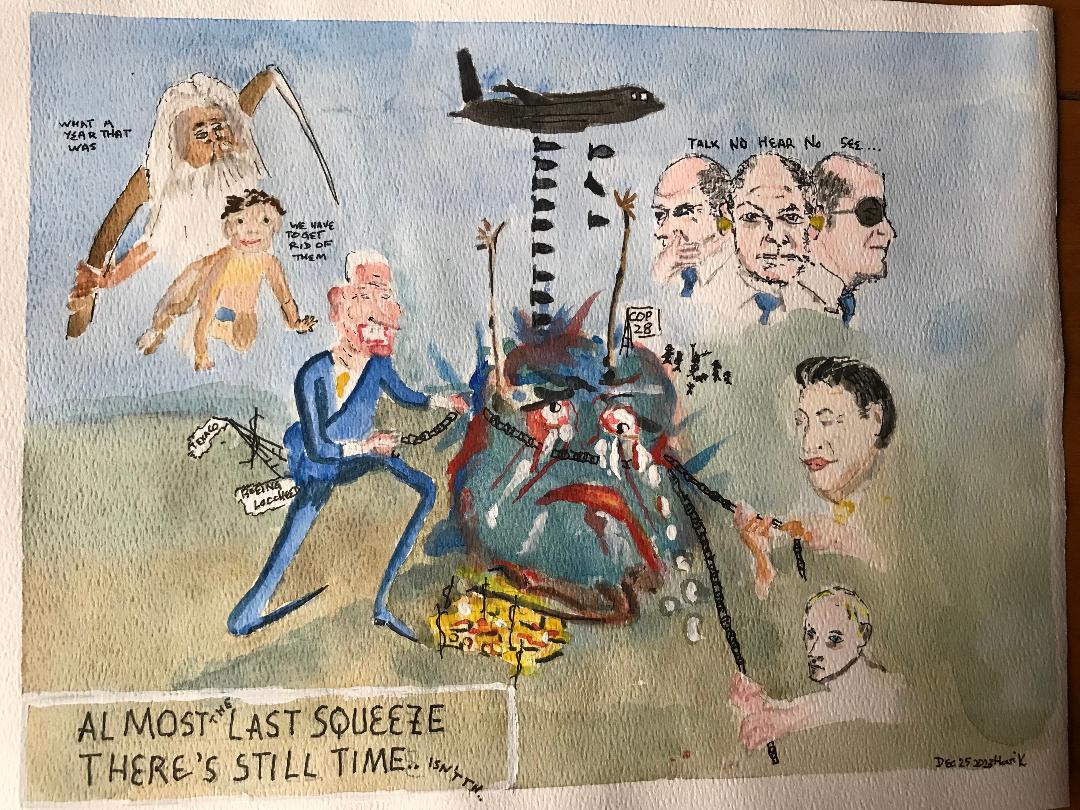
Happy New Year from theleftberlin

Drawing by Hari Kumar


01/01/2024

Good Riddance to an Imperialist Gremlin

The German conservative politician Wolfgang Schäuble is dead. Good.


28/12/2023

De mortuis nihil nisi bonum. A Latin saying reminds us to say nothing bad about the dead.

When news broke yesterday that Wolfgang Schäuble had died at 81, the entire German establishment had only good things to say about the conservative politician. Everyone, from the far-right AfD to the left-reformist LINKE, praised the great “democrat” and “statesman”

We Marxists enjoy Latin idioms (“Nihil humani a me alienum puto!”), but we have no problem saying bad things about the dead. Schäuble was one of the worst. As a leading member of the conservative CDU, he spent over 50 years in Germany’s parliament, the Bundestag, and filled countless government positions, most recently as the parliament’s president.

What stands out about Schäuble is his unabashed corruption. In the 1990s, he got at least one envelope with 100,000 German marks in cash (around 50,000 dollars or euros) from a weapons dealer. Schäuble lied about the affair at every step. He was eventually forced to resign, but the public prosecutor decided not to press charges.

Such a scandal would have ended a political career in almost any other country. Germany likes to think of itself as almost free of corruption. In reality, German politicians have turned corruption into a high art. For Schäuble, this was a tiny speed bump, and he was brought into Angela Merkel’s cabinet just five years later.

As finance minister starting in 2009, Schäuble gained notoriety as the main enforcer of brutal austerity dictates against crisis-ridden Greece. He forced the Greek government to drastically cut spending for hospitals and schools in order to pay off German banks. Schäuble ruled out of a monstrous Nazi building in central Berlin, while his agents in Athens ordered the privatization of state assets.

Schäuble was no less brutal towards working-class people at home. He helped turn Germany into a land of temporary contracts and low wages, while the heirs of Nazi billionaires pay almost no taxes. His legacy is the the Schwarze Null (Black Zero): a “debt brake” was introduced into the constitution, requiring balanced budgets and permanent austerity. Anyone who enters Germany’s crumbling schools and understaffed hospitals can see Schäuble’s life’s work.

The man’s entire lifetime was dedicated to strengthening the German bourgeoisie by attacking poor people at home and abroad. Before his stint at the finance ministry, Schäuble was interior minister, and he gave the police vast new powers of surveillance and repression.

Before that, Schäuble was the main architect of the reforms that bulldozed East Germany’s economy within just a few years. This shock therapy, combined with the work of West German secret services full of Nazis, has led to an enormous surge in right-wing politics in the former German Democratic Republic. When Schäuble is praised as a “democrat” today, it’s hard to think of anyone who did more to encourage fascist politics.

On the international Left, Schäuble’s death might not provoke the same joyous parties as the recent demise of Henry Kissinger or Elizabeth II — let’s take a moment to remember how much fun it was when Thatcher died!

Socialists in Germany, though, are happy that this imperialist gremlin is gone. Schäuble stood for the profound cynicism as the heart of capitalist “democracy”: he would repeat liberal phrases while dropping bombs, cutting wages, and grabbing for piles of cash. He was an imperialist down to his bones. Instead of praising him, like all German politicians are doing, we should say many bad things about the dead.