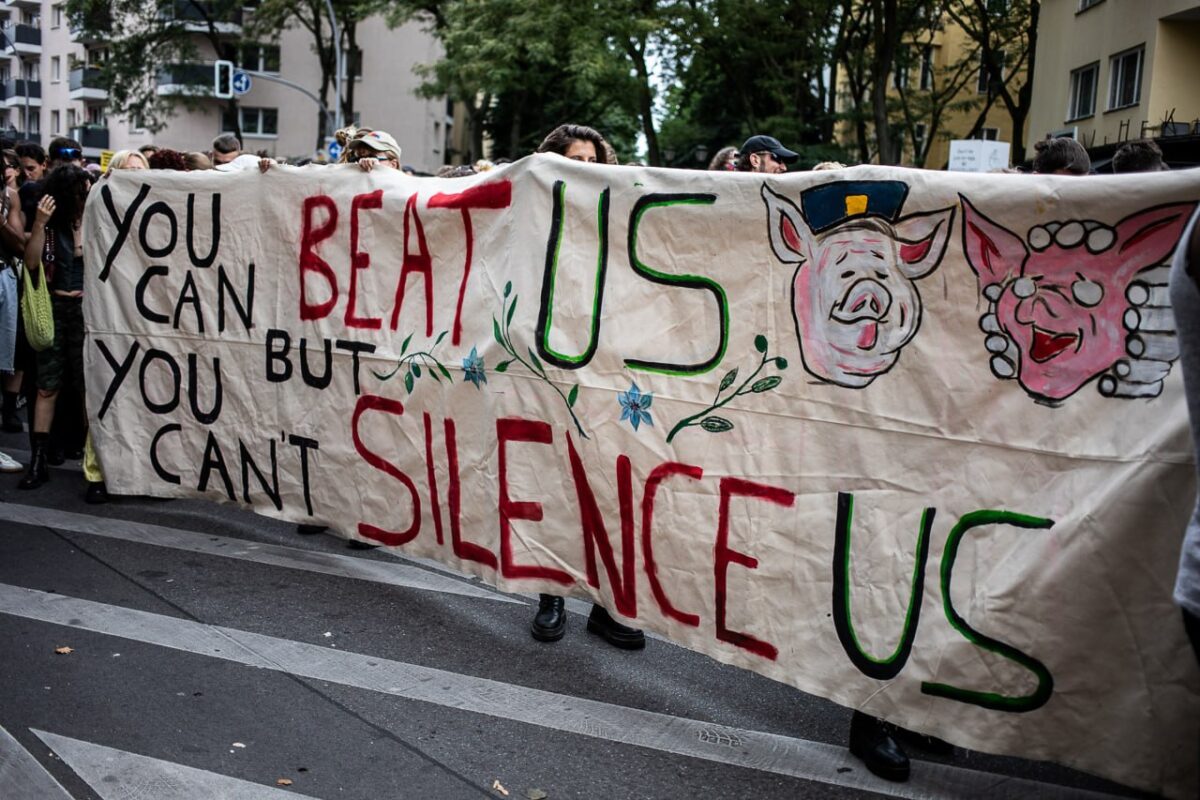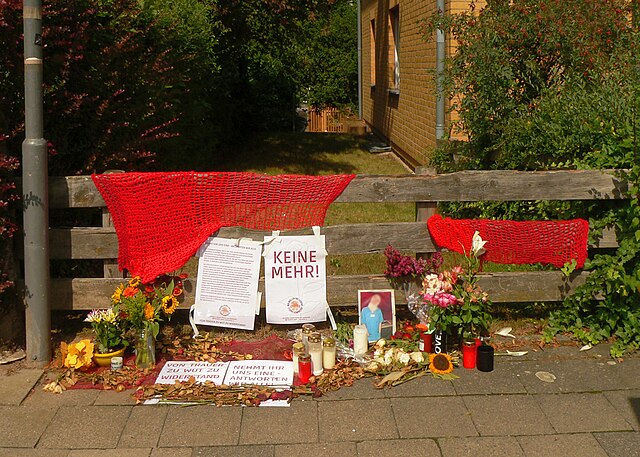
This year in Germany, at least 132 women and two girls were killed in femicides. While using women’s security to push its racist agenda, the CDU is only endangering women even more.
As the end of December approaches, and about one month after the International Day for the Elimination of Gender-based violence, it is time to look back at the situation for women in Germany this year. One thing has not changed compared to previous years: women are still killed for being women—this year, at least 134.
While the CDU claims to defend women’s rights, it simultaneously endangers women by cutting the very budgets meant to protect them and by instrumentalizing women’s rights to justify racist policies. Fighting femicide is only possible by increasing funding for women’s projects and finally paying women (fairly) for the (unpaid) work they do.
In Germany, there is no legal term for femicide. It is however described by the Istanbul Convention, signed by Germany in 2018, as the killing of a woman because of her gender. Under this definition, two different kinds of femicides are sometimes distinguished: when women are killed for a sexist motive—for example, because they do not follow typical gender roles—and when women are killed because their position in society makes them vulnerable to such killings—for example, because of their lack of financial independence or their care duties.
The definition of femicide is still broad and leads to different ways of counting femicides, as there are different ways of identifying the motivations behind the killings. The quickest way to shed light on femicide is to look at press reports and count the cases of women killed by someone they knew. This is what onebillionraising.de does, and this is where the number of 134 girls and women comes from.
Another way of getting statistics on femicides is to use criminal and police statistics. This allows access to more cases than press reports but has the drawback that the waiting time to get the data is a bit longer. In the “Femicide in Germany” report, the German Institute for Human Rights analyzed criminal and police statistics in order to quantify and analyze femicides in Germany.
What the authors find is that in 2024 in Germany, 824 women and girls were victims of attempted femicides. This means that in 2024, there were more than 2 attempts per day to kill a woman. 300 of these attempts were perpetrated by the victims’ partner or ex-partner. In Germany in 2024, almost every day a woman or a girl was the victim of a killing attempt by her partner or ex-partner. Moreover, 144 perpetrators were family members of the victims.
This means that more than 50% of attempted killings of women come from the close circle of the victim. By comparison, less than 15% of attempted killings of men were perpetrated by their (ex-)partner or family members. This indicates that the place where women are least safe is the private space and contradicts the racist uses of feminism by right-wing actors, who argue that the real threat to Western women comes from immigrants in public spaces. The most dangerous people for women are their (ex-)partners or family members. In Berlin, however, CDU mayor Kai Wegner decided to close the Görlitzer Park at night after an accusation of rape in the park. He did so while reducing the budget for women’s projects and spaces, spaces that are crucial in fighting femicides, as they offer an escape to the outside for women who are victims of violence in the private sphere. Moreover, in 2024, the CDU closed two girls’ projects in Berlin Kreuzberg-Friedrichshain because of the private engagement of some of its workers against the genocide in Palestine, a genocide in which thousands of women are killed with German weapons.
Indeed, a recent study on femicide in Germany shows that the lack of places in women’s shelters (buildings dedicated to women who are victims of domestic violence) is decisive in femicide: several cases analyzed occurred because of failed attempts to secure a place in a women’s shelter. According to German law, the country should have 21,000 places in women’s shelters to protect women against domestic violence, but it currently only has 7,000–8,000. Moreover, other spaces are crucial to protect women from domestic violence and femicides, such as cultural spaces or (legal) advice centers, as they allow women to maintain connections with the outside world while being at risk in the private sphere. Education and support programs for violent men are also needed, as well as educational programs for children, to combat sexist violence. By cutting the budget for women’s spaces—including shelters and associative projects that provide women with a connection to the outside—the CDU thus decides to endanger women and put them even more at risk, while using their security as a fake argument to pursue its racist agenda and criminalize people of color living in or spending time in Görlitzer Park at night.
At the national level, a new law introduced by the Greens and the SPD has been passed with the support of the CDU. It will provide more funding for women’s shelters and new rights for women who are victims of domestic violence. This, however, will only come into effect in… 2032. In the meantime, men continue to kill women: this year, at least 134.
Finally, women’s shelters and women’s projects won’t do the job alone: women will only be safe once they are financially independent from men. This is only possible by achieving economic equality between men and women. Currently, women are paid 16% less than men in Germany. This gap is even larger for women of color and does not take into account the reproductive work that women do for free. It also does not capture the full extent of economic inequality, as other factors play a role, such as the unequal distribution and taxation of money in heterosexual marriages. Providing fair wages for care and reproductive work, which is disproportionately performed by women, often migrant women and either unpaid or poorly paid, is one of the many necessary steps to achieve economic equality between men and women, and, with it, to protect women from violence by men This, however, is only possible by changing the structure of the capitalist system, which relies on the exploitation of women, and especially women of color, in order to persist.
We won’t achieve security for women by racist measures, and the CDU won’t defend our rights. Moreover, we want more than the weak law pushed by the SPD and the Greens. What we wish for in 2026 to fight femicide in Germany is therefore an immediate increase in the budget to protect women when they are at risk by creating more places in women’s shelters and financing women’s projects instead of cutting their budgets. But also, and perhaps even more importantly, we want women to finally get paid (fairly) for their work so that they are independent from the greatest danger they face: the men in their private spaces.