On 1 January 1994, the presidents of the USA, Canada and Mexico launched the North American Free Trade Agreement (NAFTA). NAFTA removed trade restrictions and opened up Mexico to exploitation by the so-called “free” market. Mexican president Carlos Salinas had prepared the way with a massive privatisation plan four years earlier. In 1992, Salinas repealed Article 27, which had enabled peasants to use disused land.
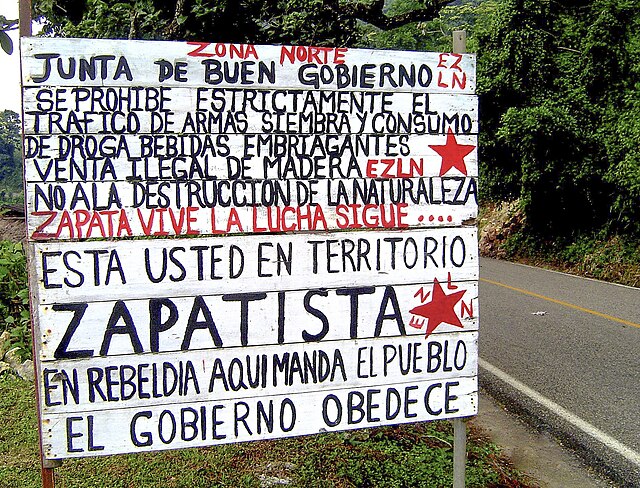
1 January also saw the Zapatista uprising in Chiapas. Mayan Indigenous people took control of four cities, including the state capital, San Cristóbal de las Casas. They demanded land reform, Indigenous rights and democracy. The EZLN, which led the uprising, was named after the Mexican revolutionary Emiliano Zapata. The spokesperson for the movement was its masked leader, Subcomandante Marcos, who announced that the EZLN were fighting not only for Mayan rights, but against global neoliberalism.
Addressing movements in other countries, Marcos issued a statement declaring:
“We are you. Marcos is gay in San Francisco, black in South Africa, an Asian in Europe, a Chicano in San Ysidro, an anarchist in Spain, a Palestinian in Israel, a Mayan Indian on the streets of San Cristóbal, a Jew in Germany, a Gypsy in Poland, a Mohawk in Quebec, a pacifist in Bosnia, a single woman on the streets of the metro at 10pm, a peasant without land, a gang member in the slums, an unemployed worker, an unhappy student.”
The Zapatistas became a symbol of the international struggle against globalisation. They organised the first major defeat for Western capitalism after the fall of the Eastern Bloc in 1989. They forced the Mexican government to make concessions, including improved healthcare and sanitation and increased farm prices. However, following pressure from multinational corporations, most of these agreements were never respected.
As a result of the Zapatista uprising, the PRI ruling party lost its first presidential election in seven decades. It was replaced by the right-wing PAN. When the PRI returned to government, it continued to impose cuts and privatised the national oil company, PEMEX, in 2013. The Zapatistas said they were building autonomous spaces and were not interested in taking state power. Unfortunately, this left neoliberal capitalism firmly in control of Mexico. We should celebrate their victories and learn from their mistakes.