Part 2 of 2
Editor’s note: Read Part 1 here.
From protocol indignities to ‘non-binding’ progressive policies and revealing omissions
What’s wrong with the documentation laboriously prepared in 2025 in those 130 meetings, putatively to guide G20 collective policy and action? Simply: another case of talk left, walk right.
Pretoria’s choice of three progressive theme words – solidarity, equality, sustainability – was uplifting, and were quickly recognised as the precise opposite of the new Trump regime’s agenda. As Rubio blurted out on X.com back on February 5: “I will NOT attend the G20 Summit in Johannesburg. South Africa is doing very bad things. Expropriating private property. Using G20 to promote ‘solidarity, equality, & sustainability. In other words: DEI [diversity, equity and inclusion] and climate change’.”
The provocative themes can be credited to the ‘sherpa’ guiding the process: Zane Dangor, director general of the Department of International Relations and Cooperation. Five years ago, Dangor wrote (in the country’s main ezine) of his desire to hear voices of “eco-feminists/eco-socialists,” whose “ideas are required if we are to build a new politics that can improve the well-being of all people on a healthier planet.” He represents one of the finest cases of catapulting from South Africa’s liberation tradition into civil-service realpolitik, so it was no wonder that progressive NGOs took Dangor’s leadership and the three theme words at face value, and that so many joined the various drafting processes.
Gilad Isaacs, the director of what is probably the most ambitious and effective of these, the Johannesburg-based Institute for Economic Justice, expressed optimism on November 22: “The U.S. boycott will not derail the work. The credibility of the presidency will be measured not by the presence of any one country, but by whether the agenda set in the interests of the Global South is carried through and used in other forums.”
But in reality, derailment of all progressive G20-legitimating work is inevitable. One reason is the Declaration’s continual resort to two weasel words – ‘voluntary’ and ‘non-binding’ – in vital areas where capitalism desperately needs major doses of nationalization, or at minimum tough regulation:
“we welcome the G20 Critical Minerals Framework, which is a voluntary, non-binding blueprint… we welcome the Voluntary and Non-Binding G20 High-Level Principles on Sustainable Industrial Policy for Inclusive Economic Growth, Industrialisation, Jobs and Equality… We discussed the need for improved integrity, and interoperability in carbon credit markets and note the voluntary and non-binding Common Carbon Credit Data Model… we note the South African Presidency initiative on a G20 Africa Cooperation Agenda on Trade and Investment, which is a voluntary and non-binding initiative… [and] look forward to the roadmap towards the implementation of Voluntary and Non-Binding High-Level Principles on Combating Illicit Financial Flows.”
Vicious U.S. politicians will inevitably make fun of this wishy-washy posturing, with Treasury Secretary Scott Bessent already declaring, “We have whittled down the G20 back to basics … the G20 had become basically the G100 this past year. So it will be a concentrated group in Miami, seeing the best America has to offer, with American leadership.”
Indeed, Washington’s role in delimiting Dangor’s wordsmithing was apparently effective, as a New York Times reporter documented on November 15: U.S. functionaries “had spent much of the year drawing red lines, skipping working meetings and refusing to negotiate in the lead-up to the final gathering in Johannesburg. The moves, they said, put into stark relief Mr. Trump’s aggressive foreign policy and distaste for multilateralism, compromise and anything he considers political correctness.”
In scaling back G20 energy-access rhetoric, the Times named Argentina, Saudi Arabia and Turkey as Trump’s saboteur allies. And on public health, “The U.S. delegation said it could collaborate on fighting noncommunicable diseases like cancer, but issues of equity, universal health care and support for the World Health Organization were non-starters.”
Another example comes from a Media20 effort where a local reform leader, Michael Markovitz, wrote on FB how “we must also be honest about what was left out.” His team’s backroom support work on the M20 declaration – “endorsed by more than 70 organisations” – “set out four priorities essential to democratic resilience: information integrity, media sustainability, journalist safety, and the survival of public interest journalism.” But as a dismayed Markovitz discovered,
“None of these issues appear in the final Leaders’ Declaration at the G20 South Africa. There is no reference to information integrity. There is no acknowledgement of journalism’s role in safeguarding democracy. These are not minor omissions. In my view, it is a governance failure at the level of the G20. It is a gap that weakens the credibility of the multilateral system at the moment democracies need it most… If the information ecosystem is poisoned, every G20 goal becomes harder to achieve. Climate action, inclusive growth, digital cooperation and peaceful societies all depend on trusted information. In its absence, trust in important public institutions will continue to be eroded.”
G20 starves us of peace and food sovereignty
Even where host South Africans might have been ambitious in making demands, three other barriers arose to a serious declaration with implementation accountability: hypocrisy, a limited world view and upward-gazing elitism. On food security, for example, Ramaphosa had firmly signalled solidarity-equality-sustainability values in November 2024, at the Rio de Janeiro summit, beseeching fellow leaders that the G20 “must be capable of combating the use of hunger as a weapon of war, as we are now seeing in some parts of the world, including in Gaza and Sudan.”
Yet five days earlier, his lead minister within the SA Presidency – Khumbudzo Ntshavheni – vocally advocated systematic starvation as a weapon of class war, against thousands of underground informal-sector gold miners about two hours’ drive southwest of Johannesburg, in Stilfontein: “We are not sending help to criminals. We are going to smoke them out.” Ntshavheni knew the consequences, because two weeks before that, she had bragged to the media how the police and army “blocked communities in and around these abandoned mining shafts in Orkney from delivering food parcels, water and necessities to these illegal miners.”
As a result, starving mineworkers were forced to eat cockroaches and human flesh. It is likely that, by mid-January 2025 when courts finally ruled Ntshavheni’s murderous practice must cease, many dozens or even hundreds of mineworkers had died due to starvation or, because in a desperately weakened state, they had tried to escape by climbing up extremely steep mineshafts – falling to their deaths.
There was much more hollow, hypocritical rhetoric in the Johannesburg Leaders’ Declaration, e.g., “We will work for a just, comprehensive, and lasting peace in Sudan, the Democratic Republic of Congo, the Occupied Palestinian Territory, Ukraine, as well as ending other conflicts and wars around the globe.”
Those crafting the Declaration’s vapid phrasing were too fearful to name the aggressors and profiteers – much less arrange punishment – in the four cases, which range from capitalists within the BRICS such as Emirati gold traders and Russian (Wagner Group) soldiers in Sudan; to Chinese and Johannesburg- and London-listed mining houses in the eastern DRC; to all G20 economies’ firms which trade with Israel; to Russia killing hundreds of thousands of Ukrainian (and Russian) workers – yes, provoked initially by the G7’s eastward NATO military expansion but still inexcusable, and justifying a unified intervention to punish Putin effectively, to force him to return stolen territory (and children) and to pay reparations, in lieu of Trump’s incompetent Ukraine-surrender plan.
And speaking of Gaza, Ramaphosa’s brother-in-law Patrice Motsepe is still fueling the Israel Defense Forces with coal he co-supplies its power plants (and 18% of the genocidaires’ grid), alongside Ramaphosa’s former coal-mining partners at Glencore, dating to the late 2000s in both cases. This fuel violates an ICJ ruling in July 2024 that states must halt “aid or assistance in maintaining the situation created by Israel’s illegal presence in the Occupied Palestinian Territory”, and a United Nations General Assembly resolution two months later (with a vote of 124 for, 14 against) for states to “prevent trade or investment relations that assist in the maintenance of the illegal situation” – plus Pretoria’s repeated Hague Group commitments to respect UN courts and prevent fuel from reaching the military.
Notwithstanding Palestine Solidarity Campaign protests at Motsepe’s offices and weekly demonstrations at Glencore’s Joburg headquarters, neither Ramaphosa nor the other G20 genocide collaborators had anything specific to say in the Leaders’ Declaration about the ICJ or International Criminal Court, which indeed they are actively undermining in relation both to Palestinians and climate justice, in view of an ICJ ruling in July that states (mainly G20 members) should pay their climate debt.
Other high-minded hypocritical fibs pothole the Leaders’ Declaration: “We affirm our unwavering commitment to act in accordance with international law including international humanitarian law and the Charter of the United Nations and its principle of peaceful settlement of disputes and in this regard, we condemn all attacks against civilians and infrastructure.” Yada yada.
When it comes to hunger crises, other important words are unmentionable in either the Declaration or G20 Food Task Force statement: multinational agribusiness, intellectual property, genetic engineering, carnivore, profiteering and speculation. These terms are not to be found, because they are assumed to be a natural part of corporate agriculture – although all undermine food sovereignty and climate sanity. Reforms like “land redistribution” and “agro-ecology” and genuine peasant empowerment are not mentioned; for they would violate the G20 Food Task Force’s commitment to “pursuing actions that are in compliance with WTO rules and obligations.” The G20 declaration pushes ‘food security’ phraseology without any concession whatsoever to the objectives of grassroots food sovereignty movements.
In addition to ignoring the content demanded by progressive anti-hunger and food-system activists, the most obvious aspect of any G20 official statement is silence about – and thus disrespect for – processes of civil society mobilisation. The G20 Food Task Force statement ignores courageous movements around the world, e.g. the Via Campesina network, whose members have struggled valiantly for land redistribution and pro-peasant policies.
So civil society should have had no expectation of being taken seriously by the G20 in Johannesburg, within a country where more than 12 million of the 62 million population is considered to be food insecure, led by a hedonistic ruling class that exudes subimperial obeisance to agricultural imperialism.
Financial imperialism
The same upward-gazing obsession could be observed in the G20’s highest-profile task force – led by the same Trevor Manuel who bailed out the IMF in 2009 – on ‘Growth, Debt and Development’, which was aimed mainly at alleviating the home continent’s worsening fiscal crises, e.g. through IMF gold sales. The mass protests and demands from so many African movements where unrest has been intense in recent months – from Madagascar and Mozambique, up to Morocco and Tunisia – are not referenced, much less acknowledged and respected.
Specifically unmentionable for G20 financial-reform bureaucrats are the clear strategies coming from Kenya’s Gen Z since mid-2024, for example, demanding ‘debt audits’ to determine whether corrupt lending for corrupt projects should be considered ‘Odious Debt’ – so that the creditor takes a haircut, not just society’s most vulnerable. The two biggest South African parastatal debtors – Eskom electricity (for the Medupi and Kusile coal-fired power plants) and Transnet (for Chinese locomotives) – are obvious cases in which the fiscal burden of corruption soared over the past two decades due to Pretoria taking on foreign loan repayment obligations, even in cases where lenders like the World Bank were obviously implicated in the Odious Debt burden due to oft-acknowledged graft or project maldesign.
Many other civil society forces across Africa argue for ‘reparations’ based on standard ‘polluter pays’ principles, to be paid as ‘climate debt’ by the big Western and BRICS greenhouse gas emitters – including China, which is owed a substantial share of Africa’s foreign debt. Such ideas dare not be mentioned by Manuel’s small-minded team, so perhaps his declaration’s sentence of greatest merit is this: “Over recent presidencies, the G20 has debated Multilateral Development Bank reform, debt sustainability, and climate finance, yet progress has been slow and credibility is waning.”
One feature of waning credibility is non-acknowledgment of conflicts of interest. For many months, debt activists have worried that if Manuel – as chair of this commission, and the most effective neoliberal politician in the country’s history – also runs institutions that have African sovereign financial instruments among their assets (e.g. Africa’s largest insurance company, and the local branch of the notorious Rothschilds), then there is little hope for South Africa’s G20 presidency.
Moving to the Leaders’ Declaration, “We continue to urge the international community to support vulnerable countries with a strong reform agenda whose debt is sustainable but are facing liquidity challenges and encourage the IMF and the World Bank to continue their work on feasible options to support these countries, which should be country-specific and voluntary.” Translation: Africa’s toughest neoliberal finance ministers – aiming to privatise and to cut social spending (i.e. that ‘strong reform agenda’) – need to load on yet more debt, to swamp current and future generations with permanent structural adjustment obligations.
Climate chaos confirmed
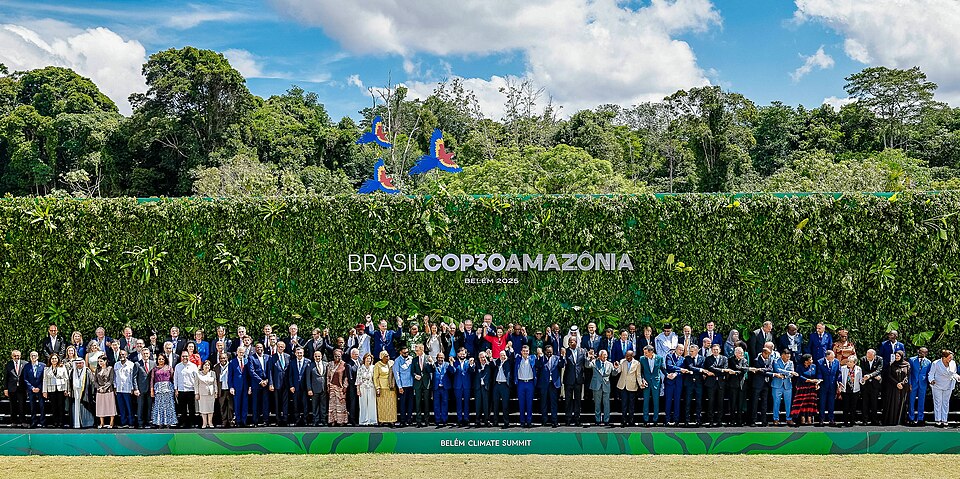
The Leaders’ Declaration was correct to brag about the COP30: “We highlight the successful outcomes of the 2025 United Nations Framework Convention on Climate Change Conference COP30 in Belém.” After all, ruling classes from the G1, the other G7s and the BRICS have – since the 2009 Copenhagen Accord – resolutely lined up against everyone else, on three foundational positions:
1) do not agree to cut emissions or leave fossil fuels underground to the extent necessary to save us all from planetary catastrophe;
2) do not admit you emitted by acknowledging the ‘polluter pays’ principle because you’ll face liability claims, and have to pay ‘climate debt’ and reparations (as even the ICJ in July 2025 ruled is logical);
3) instead, do limit climate finance to loans, and ‘privatise the air’ through carbon markets, dubious offsets and other emissions-trading gimmickry.
From these three standpoints, COP30 was a roaring success for the G20 ultra-polluters. One obvious conclusion is that a ‘Global North’ (bad, villains) versus a ‘Global South’ (good, victims) is not an appropriate framing. Instead we have a configuration that allows the COP30 – like so many before it – to fuse imperial and subimperial interests. Speaking to the BBC, Li Shuo of the Asia Society remarked, “This partly reflects the power shift in the real world, the emerging power of the BASIC and BRICS countries, and the decline of the European Union.” (BASIC is Brazil, South Africa, India and China).
The BBC continued, “US President Donald Trump stayed away, but his stance emboldened his allies here. Russia, normally a relatively quiet participant, was to the fore in blocking efforts on roadmaps [to phase out oil, gas and coal]. And while Saudi Arabia and other major oil producers were predictably hostile to curbing fossil fuels, China stayed quiet and concentrated on doing deals.”
In addition to the U.S. – also absent from Belém due to Trump’s anti-science climate denialism – and Russia, the 24-member ‘Like Minded Group of Developing Countries’ is to blame for preventing fossil fuels from being left underground: Algeria, Bangladesh, Bolivia, China, Cuba, Ecuador, Egypt, El Salvador, India, Indonesia, Iran, Iraq, Jordan, Kuwait, Malaysia, Mali, Nicaragua, Pakistan, Saudi Arabia, Sri Lanka, Sudan, Syria, Venezuela and Vietnam. Of these, 11 are BRICS members, partners and invitees. The London Overseas Development Institute named China, India, Russia, Saudi Arabia and the United Arab Emirates as the main forces preventing even mention of a fossil fuel phase-out. The Financial Times reported that UN Secretary General António Guterres singled out the Saudis for most of the wrecking blame.
But Pretoria also helped foil COP30 climate-adaptation work because of a surreal personality battle within Ramaphosa’s centre-right co-governing party, the Democratic Alliance. The white-dominated 25%-supported party had won the right to name an environment minister in a Government of National Unity after the last election, in July 2024, and chose Dion George – whose background in corporate finance in the ultra-corrupt Sandton central business district of Johannesburg and his unashamed role as an apartheid-era soldier lowered expectations. George was sufficiently subimperialist in orientation that he was chosen as the UN’s COP29 co-chair on emissions mitigation in 2024 and COP30 co-chair of adaptation.
Those roles meant that when African delegations walked out of the COP29 in fury, he could stay behind and side with the rich climate vandals, so as not to spook the G20. Yet when it came to protecting lions and other big game from hunters, George’s traditional version of conservationism ran up against white game-farming and wildlife-trafficking interests, and so unceremoniously he was dumped as minister just as the COP30 began, replete with sleazy rumours of sexual harassment that he vows to take up in a libel suit.
But overall, as climate advocacy groups argued, the firing of George “gives the perception that the South African government is not serious about climate change or its leadership in the negotiations, despite this being a crisis that threatens the fundamental social and economic aspirations of all in South Africa.” The perception is the reality, of course, with Pretoria seeking not only to keep coal-fired power plants open much longer than promised in its Just Energy Transition Partnership fundraising, but to initiate massive new methane gas processing investments from the World Bank to better import the $12 billion in promised purchases from Trump’s U.S. oil company mates, or from local digging by Shell and Total, joined recently even by Brazil’s Petrobras.
Johannesburg’s decorative but ineffective bottom-up counter power
South African society had not been particularly well mobilised to deal with the contradictions, compared, say, to the most intense G20 counter-summit and protest, which was in Hamburg in 2017. On Friday just before the leaders’ summit began, a national Women’s Shut Down was held in at least 15 cities, protesting gender-based violence. In the centre of town from November 20-22, there was a ‘We the 99%’ festival with several thousand participants demanding global economic justice, drawing on ‘Fight Inequality Alliance’ advocacy and the local New Economy Hub.
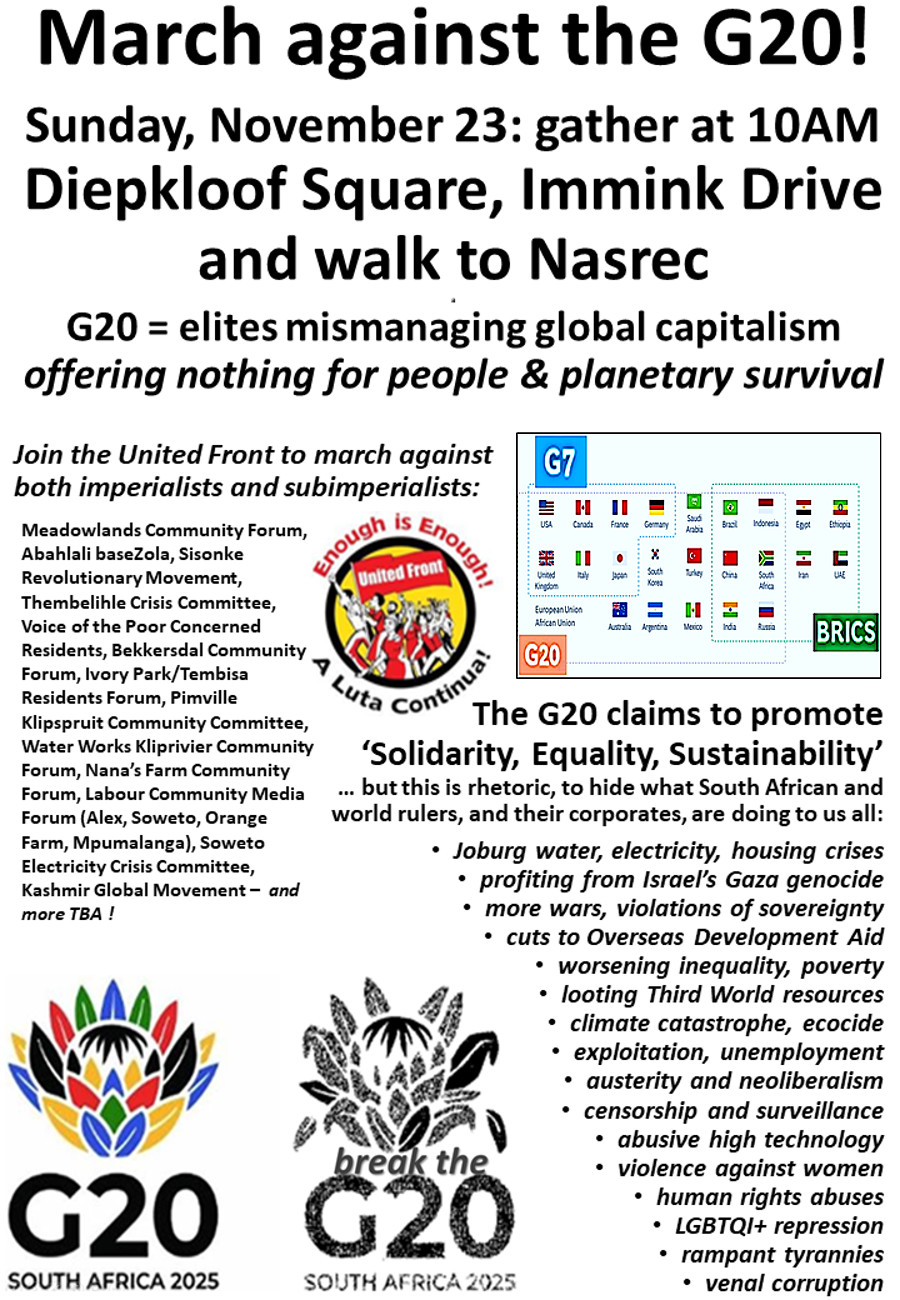
And Johannesburg’s United Front movement mobilised 350 community activists to march nearly an hour from Soweto to the conference site on the final day. Most aesthetically appealing was the way a small artivist network, Camp, decorated some of the city’s best-known skyline buildings with a political light show.
But two other forces of dissent made more of a dent in the local news. A few dozen right-wing populist xenophobes (‘Operation Dudula’) protested the very idea of regional solidarity, alongside former president Jacob Zuma’s MK Party, on November 22, and attracted police tear gas and arrests near the conference site. Second, the main municipal trade union traded off a $235 million back-pay settlement with the mayor of Johannesburg, in exchange for a promise not to disrupt the event (an earlier threat, later denied).
The latter deal may have solved a problem for Johannesburg authorities in the short term, but also has generated awareness of the flimsy nature of municipal management, especially in a wet period that, just days before the G20 summit began, witnessed severe flooding and inadequate stormwater drainage – again revealing the country’s and city’s notorious lack of attention to climate adaptation and resilience.
And the mayor’s promise that during the G20, water would flow uninterrupted to all parts of the city – a source of sustained protest – was also broken, as predicted by the city’s lead water activist, Ferial Adam: “The contrast could not be starker: our government is spending close to R1-billion for a global summit in Sandton while nearby informal settlements and suburban residents alike cannot get a single bucket of clean water.”
These were merely indications of the way such depraved ‘North-South’ partnerships are being generated through G20 co-optation of South African elites, and indeed also within the COP process as well, as Lula’s recent role confirmed. It’s all too reminiscent of what a white-supremacist Rhodesian leader, Godfrey Huggins, described as the preferred neo-colonial arrangements he foresaw in managing racist rule (from 1933-53), in what later became Zimbabwe, South Africa’s immediate northeastern neighbour: a “partnership between a rider and a horse.”