Part 1 of 2
Editor’s note: Read Part 2 here.
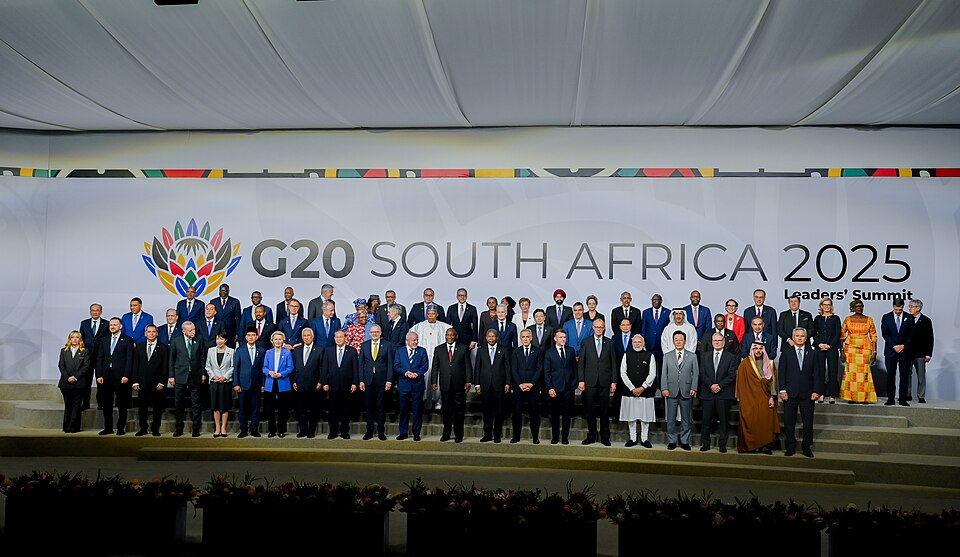
The third weekend in November offered the world two disastrous days for solving polycrisis problems, starting in the Brazilian Amazon city of Belém at the United Nations climate summit (‘COP30’) on November 22, just as South African President Cyril Ramaphosa hosted (most of) the Group of 20 leaders in Johannesburg. The G20 comprises 19 of the world’s major economies plus the European Union and, in 2023, the African Union was added (tokenistically).
The body was formed in 1999 as a finance ministers’ club at a Berlin meeting, at a time of nervousness about economic crises in several middle-income countries, including South Africa. But it was in 2008 that the G20 graduated to a heads-of-state annual meeting, due to deregulated U.S. banking rapidly degenerating, starting with real estate speculation, leading to Bear Stearns and Lehman Brothers collapsing. U.S. President George W. Bush was told by his financial managers that the coming global meltdown would urgently require new funding sources, especially from middle-income countries with large surplus dollar reserves.
As the G20’s first major act, South African finance minister Trevor Manuel led a committee to grant the International Monetary Fund (IMF) nearly $1 trillion worth of new funding, approved by the G20 in an April 2009 London emergency meeting. That session also coordinated central banks’ low interest rates and money printing, termed Quantitative Easing (‘QE’), so as to flood liquidity into financial markets and thus avoid a repeat of the 1930s Great Depression.
And again in 2020 during the Covid-19 crisis, G20 leaders agreed that their capitalist self-interest was sufficiently threatened by widespread pandemic-prevention lockdowns and economic seizures that further QE and much lower interest rates were needed. In addition, a brief pause on the poorest countries’ foreign debt repayments was offered. But that didn’t prevent three African economies that were among the 2010s fastest-growing in the world – Zambia, Ghana and Ethiopia – from defaulting on foreign debt repayments between 2020-23, and terrible fiscal pressure mounted across the continent.
These two financial bailouts were G20 interventions that suggest, in a time of peril, imperial-subimperial fusion can be achieved. On the other hand, intra-capitalist divisions over handling Covid-19 vaccines and treatment were not solved within the G20 from 2020-22: British and German leaders vetoed efforts by South Africa and India wanting an Intellectual Property waiver (the way AIDS drugs were made generic in 2001, saving millions of lives). Ramaphosa was at his best appealing for health justice, allied with India’s Narendra Modi; but Boris Johnson and Angela Merkel were too intent on defending their own Big Pharma firms.
Since then, the world’s crises – climate and biodiversity catastrophes, brutal wars, economic volatility, the threat of rampant Artificial Intelligence, extreme inequality and others – have multiplied, and their causes now extend well beyond the greed and irresponsibility of the traditional Western imperial powers. In 2010, when the Brazil-Russia-India-China-South Africa BRICS emerged as a counterpart to the G7, the G20’s responsibilities for global economic management were codified, but other crises were added to the workload. And the recent G20 presidencies of Indonesia (2022), India (2023) and Brazil (2024) – all BRICS members (Jakarta having joined in 2025) – highlighted the subimperial powers’ newly-significant roles, not in providing alternatives, but instead in legitimising status quo multilateralism.
Indeed, with the advent of far-right Western rulers (Trump from 2017-21 and again since January this year, and in Italy, Giorgia Meloni since 2022), and three more neo-fascist parties currently leading in European polls – Reform in the United Kingdom (which hosts the 2027 G20), the Alternative for Germany, and the French National Front – there arises the threat and reality of fast-spreading ‘paleo-conservative’, economically-isolationist, xenophobic and socially-reactionary politics.
In this ominous period, the African continent’s first hosting of the G20 was meant to build upon Lula Ignacio da Silva’s November 2024 Rio de Janeiro summit, by taking the baton on coordinated international taxation of the ultra-rich and on food security, adding ‘disaster resilience and response,’ African debt relief, climate financing for a ‘just energy transition’ and ‘harnessing critical minerals for inclusive growth and sustainable development.’ The likes of Joe Stiglitz and other progressives were even drawn into a major inequality commission – albeit one which did not have the grace to recognise any social activists’ initiatives.
From the beginning of 2025, more than 130 official meetings were held in various glamorous South African sites. Not only did G20 civil servants labour over phraseology, but so did a myriad of allied groups Ramaphosa’s team had gathered: B20 for business (guided by McKinsey and Bain in spite of being told by Ramaphosa to fire those particular consultants), L20 for workers, W20 for women, C20 for civil society, Ch20 for children, M20 for media, etc. But as the dust settles, it all appears for naught.
Rebuffed by Trump
In Johannesburg on November 22-23, the Nasrec setting for G20 leaders – minus Donald Trump, Xi Jinping, Vladimir Putin, Claudia Sheinbaum, Mohammed bin Salman and Prabowo Subianto – was very different from what Ramaphosa must have anticipated when taking over management of the bloc last December. At that point, in Ramaphosa’s most obsequious mode – so different than in mid-2018 when he scathingly criticised Trump for interfering in local land reform politics – South Africa’s leader hurriedly invited the U.S. president-elect for a formal state visit and especially for a round of golf, replete with characteristic elite chuckling about taking time off to improve his game.
The invitation was repeated as late as the disastrous Oval Office meeting on May 22, when Ramaphosa handed over a R10 000, 14-kg golf course book, and his sidekick golf pro Ernie Els thanked Trump for the CIA’s empowerment of Pretoria’s apartheid-era army during its 1970s-80s invasion of Angola plus sponsorship of right-wing UNITA guerrillas – “you guys helped us“ – which killed up to a million black Angolans.
The South African elites’ sickening sweet-talk had begun soon after SA Ambassador Ebrahim Rasool was fired in March by U.S. foreign minister Marco Rubio for remarks about Washington’s new orientation to [white] ‘supremacy.’ The first reconciliation effort was made in April by special envoy Mcebisi Jonas – but failed since he was not even allowed into the U.S. by Rubio, due to similar (truthful) insults that he’d made in 2020 about Trump’s racism and narcissism. (Jonas also chairs the huge MTN cellphone company which is under attack in the U.S. courts for dubious activities in Afghanistan and Iran, when Ramaphosa was the firm’s board chair.)
The task of Trump-whispering then fell to ultra-neoliberal trade minister Parks Tau and Ramaphosa’s investment advisor Alistair Ruiters. Trump first imposed tariffs in February, on steel, aluminium and autos, which in subsequent weeks proved devastating to South African exports. The tariffs were expanded in April and again in August, when Trump also killed the Africa Growth and Opportunity Act, which since 2000 made many goods tariff-free. At that point, three new agriculture-sector victims – citrus (later retracted), nuts and vineyard products – were hit with a 30% tariff, mainly hurting the very Afrikaner farmers Trump had pretended to support through his bizarre, unsuccessful refugee recruitment gimmick, given his presumption the Afrikaners were suffering ‘genocide’.
Trump’s on-and-off ally Elon Musk – very badly raised in South Africa, “nearly beaten to death,” as he described his Johannesburg high school’s bullying culture, which his deranged father supported – and other U.S. capitalists also insisted that Ramaphosa drop Black Economic Empowerment policy, i.e., enforced sharing of investment assets. And powerful U.S. Zionists persuaded Trump to demand Ramaphosa retract the December 2023 case Pretoria filed at the International Court of Justice (ICJ) against Israel’s Gaza genocide. While failing to change Pretoria’s policy, Washington is still contemplating a messy, apparently inadequate offer by Tau to buy $12 billion worth of U.S. methane gas plus adulterated poultry, in turn threatening extreme damage via greenhouse gas emissions and local chicken factory-farm bankruptcies.
Trump’s rejection of U.S. participation contributed to the superficial, blindly-nationalistic character of commentary within South Africa. In his last pre-summit comment, on November 7, Trump announced, “It is a total disgrace that the G20 will be held in South Africa. Afrikaners (people who are descended from Dutch settlers, and also French and German immigrants) are being killed and slaughtered, and their land and farms are being illegally confiscated. No U.S. Government Official will attend as long as these Human Rights abuses continue. I look forward to hosting the 2026 G20 in Miami, Florida!”
Miami is about 370 km south of the famous Disney World resort, where Mickey Mouse frolics. The souring of G20 diplomacy was witnessed in Finance Minister Enoch Godongwana’s (quite realistic) scenario for late 2026: “If the U.S. does not want us to participate, the only way they can do it is to decline us a visa.”
Also reflecting Washington’s cartoonish arrogance, a last-minute request was made by the U.S. State Department to allow a deputy ambassador in Pretoria to formally receive the official G20 handover on November 23. Ramaphosa demurred, for this would violate his own conservative proceduralist mentality, which in turn led Trump’s jejune (28-year-old) press secretary Karoline Leavitt to claim on November 20 that the South African president was “running his mouth a little bit against the United States”. More such insults will no doubt come from the newly-approved U.S. Ambassador to Pretoria, far-right media activist Brent Bozell, who during the 1980s regularly denounced Nelson Mandela as a terrorist. Indignity upon indignity will continue to rain on South Africa from Yankee perches.
Instead of pushing for the U.S. to be expelled from the body due to Trump’s multiple attacks on multilateralism (climate, public health, trade, aid, fascistic abuse of refugees and immigrants, genocide facilitation and other acts of geopolitical insanity including repeated invasion threats such as against Nigeria this month), Ramaphosa replied with a merely bureaucratic rationale: “America chose to boycott this summit. That’s their prerogative to do so. But what cannot happen is breach of protocol being forced down our throats.”The White House reacted on November 23 with a banal claim that Ramaphosa was “refusing to facilitate a smooth transition of the G20 presidency. This, coupled with South Africa’s push to issue a G20 leaders’ declaration, despite consistent and robust U.S. objections, underscores the fact that they have weaponised their G20 presidency to undermine the G20’s founding principles.” Indeed, Ramaphosa’s main victory was getting an 11,000-word collective Declaration out of the group, instead of merely a (self-delegitimising) ‘Chair’s Statement’. But the devils in the details soon became clear to critics.