Hi Kostis, thanks for talking to us. Can you briefly introduce yourself?
I am Kostis and come originally from Greece. I am half-German and have lived here for around 10 years. I was politicized in anti-war movements at high school and spent many years organized in SYRIZA, which I left after the big betrayal of the referendum against austerity politics.
Since then, I have been active in social movements, but not in political parties until I joined Die Linke in February. I directly joined the LAG Palästinasolidarität (state working group for Palestine solidarity). For the last few months, I’ve been in the Coordinating Group of the LAG.
This interview was originally set up after a recent Die Linke party conference, where the LAG put forward a motion, which it later withdrew. You then contacted The Left Berlin to say you’d like to explain. Let’s do this in two parts. What was the motion about?
We had two motions. One said that the situation in Palestine can no longer be described as a war, but a genocide. The other was about BDS, the Boycott, Divestment, and Sanctions movement,falsely denounced as being antisemitic.
So you withdrew both motions?
Exactly. The leadership of the Berlin party and some districts created a compromise document on the topic of Palestine. We were invited to participate in this discussion. It is important that this move came from the party leadership, and we are glad to have been invited and to have been part of the discussion.
We managed to get a few important points into this document. At the same time, it still contains some problematic passages, and overall falls short of what we consider appropriate for an internationalist, socialist party. However, if we had not participated in these negotiations, the discussion would have been between the leadership and the right-wing factions of the party, meaning the document would have been even worse.
We did manage to include some good points into the final document. Although the genocide is not explicitly defined, the description is accurate. There are strong statements against repression, occupation, settlers, torture, and anti-Muslim and anti-Palestinian racism. There is also a clear stance against antisemitism accusations against members of the party.
Our decision was a strategic compromise, and that was a risk we’re willing to take. Although it is not perfect, we see that it’s more important to have improved the decision of the complete party, rather than being the ones who sit outside and criticize.
We also see that party politics are a marathon, not a sprint. We are trying to build trust and relationships, making our positions hegemonical. We see a lot of justified criticism of our stance. But it’s much easier for small autonomous groups outside the party to take whatever positions they want.
Of course, we’ve made mistakes, but this is a learning process for us as we come from the movement and not from the party bureaucracy.
Let me summarize the criticism as I understand it. There are elections in Berlin next year. There is a serious chance that the next Berlin mayor could be from Die Linke. As a result, there is a huge degree of pressure to not raise ”controversial” issues in the party before the election. The criticism is that the nearer the elections get, the more Palestinians will be thrown overboard.
We will never drop the issue of Palestine. We are committed to raising awareness of this issue and advocating clear internationalist policies within the party. We are also ensuring that the issue of Palestine is not excluded from the election debate. The programme debate is about to begin, and we intend to incorporate positions in solidarity with Palestine into the party programme.
Do you think that it’s a problem that the discussion wasn’t held at the party conference?
Yes, I think it’s a major issue that we treat the subject of genocide as controversial. The entire international left is discussing this publicly, and we should not be afraid.
At the moment, whenever any left-wing party talks about elections, they like to talk about Mamdani. He is inspirational. He increased his support from 1% to 50%. This makes us optimistic that Die Linke can win a broader majority.
At the same time, however, we have failed to see one thing that Mamdani did. He never wavered in his positions when he was accused of antisemitism. Rather than watering down his positions on Palestine, he came together with progressive Jewish organizations.
This is an important lesson on how you approach elections. If you try to hide issues, you will probably face problems from the media later on. You have to be honest and clear, otherwise you can be easily attacked.
Let’s talk about what has happened since the party conference. Ramsis Kilani was expelled from Die Linke last week. Andreas Büttner was not. Büttner is the “Antisemitism commissioner” for Brandenburg. He says that the Golan Heights belong to Israel and that the police were right to attack Palestine demonstrators. There was an attempt to get him expelled which did not even get to a hearing. Does this show a problem in Die Linke?
Firstly, and on behalf of the LAG, I would like to express our solidarity with Ramsis. He is and always will be our comrade. He was subjected to a campaign of defamation, lies and statements taken out of context. It followed the narrative of the bourgeois media. It is absurd that people would fight one of their own comrades in a coalition alongside the Springer Press and other media outlets that are hostile towards Die Linke.
We’re being told that this committee that expelled Ramsis is independent, but exactly the comparison with Büttner shows that the issue is deeply political. If you see the things that Büttner has said on social media—thanking the Berlin police for beating us up and saying that the Golan Heights belong to Israel—it goes against human rights, international law and common decency. He should not have any public platform in a left-wing party. At the same time, we don’t come from a Stalinist tradition. We didn’t call for Büttner’s expulsion.Nevertheless, I still find it a very relevant example when one discusses the political motivations behind Ramsis’s expulsion. If we were so strict about our positions and our programme, Büttner should not have been in the party.
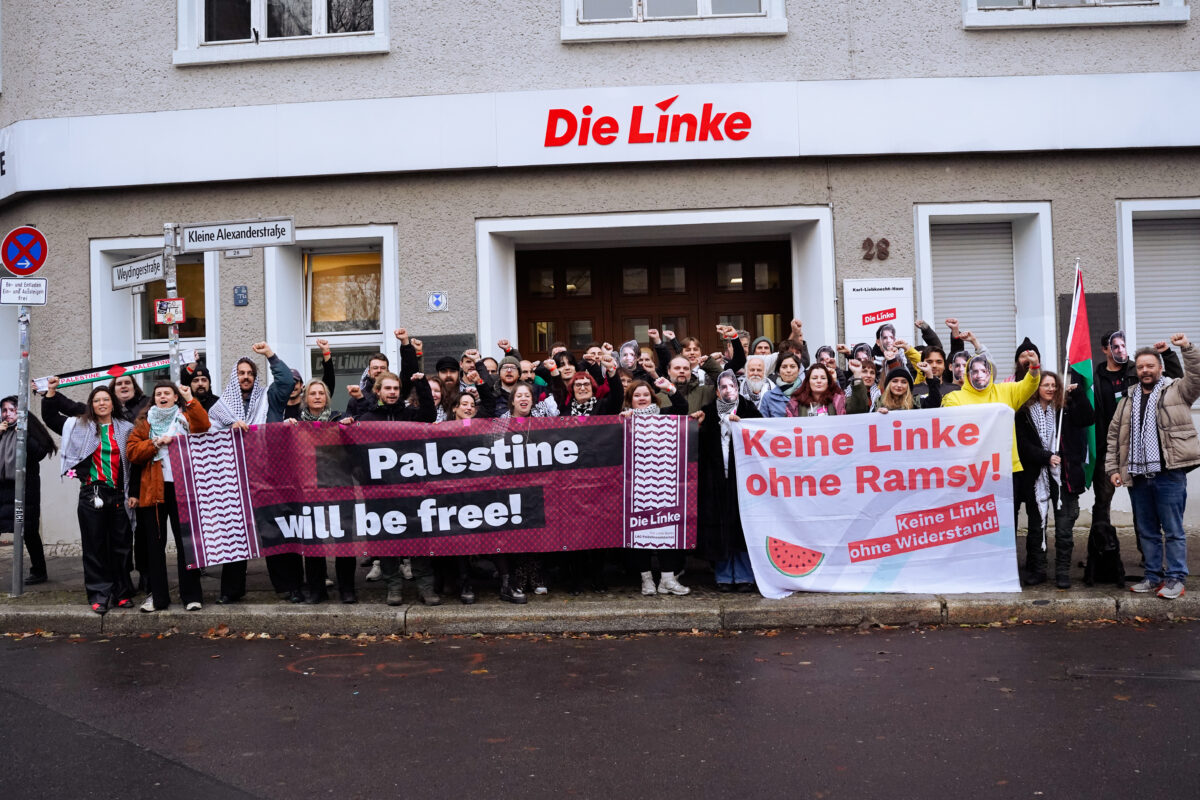
Following Ramsis’s expulsion, the LAG led a brief occupation of Karl Liebknecht Haus and made six demands.
As we just discussed, we wanted to compromise, in order to present a united front at the Berlin Conference and work towards a broader majority within the party. One of the most important points that we wanted to bring into the document on Palestine was a criticism of the repression of Palestine Solidarity and the instrumentalization of antisemitism.
Yet just a few weeks later, we see Ramsis expelled and the French Left comrades having a room cancelled a few hours before their meeting. These are not the only examples. The occupation was a symbolic gesture saying: “That’s enough.”
We cannot blame our comrades in the party leadership in Berlin or nationally entirely. It might have been people holding positions of power and making decisions without the agreement of the entire party. At the same time, the party is responsible for its spaces and must take a stance. It has to say: “No, this was a mistake. This should not happen again,” and express its solidarity with the victims of this repression.
One thing we are demanding is a clarification of the situation. We are demanding an end to the disgusting defamation campaign directed against Ramsis. We believe the party should apologize to Ramsis.
You did get a chance to speak to Janis Ehling, the Landesgeschäftsführer (party secretary) who visited you in the occupation. What did he have to say?
We appreciate that he came to talk with us. He also appreciated that we were there and willing to talk because we are exchanging ideas inside a broad democratic party. I would say that he mostly was there to hear our demands. We can be cautiously optimistic. He said that he agreed with many of the points we raised. But we’ve seen words before. What we need to see are actions.
The Left Berlin started as a working group within Die Linke. We had some good experiences, many bad. We were allowed to say what we liked on Palestine, but there was no change at the top. Do you believe that DieLinke leadership can be persuaded to take Palestine seriously?
We have also had both good and bad experiences. One of the best experiences we had was the core organization of the 27th September demonstration from Die Linke. One of our party leaders, Ines Schwerdtner, publicly stated that what is happening in Gaza is genocide and apologised for our silence.
This is a very positive step compared to Die Linke some years ago. However, you cannot organize one action, however great, and then consider the matter closed. We need to see continuity. We need to see further actions and participation in the movement.
Our LAG represents many new party members. Die Linke now has more than 120,000 members. And if you see the public opinion in Germany, 60% of the people say it’s a genocide and 80% are against sending weapons to Israel. These people have not yet had the opportunity to participate as delegates in party congresses, because they’re new members and there have been no elections yet.
We can be very optimistic that the younger people do not carry the burden that the older and more conservative left bureaucrats might be carrying.
Ines Schwerdtner did say that Die Linke has learned from mistakes it made on Palestine. Within two months of her saying that, Die Linke refused Karl Liebknecht Haus for a meeting on the flotilla. They confirmed Ramsis’ expulsion. Do you really think that they’ve learned from their experiences? Or are these just empty words?
Things are complex and Die Linke is a pluralistic party. Many institutions such as the management of Karl Liebknecht Haus and the Landesschiedskommission (which decides on expulsions) are independent. They can decide something that goes against Ines or us or maybe against the right wing.
The party isn’t responsible for all of the things that happened. However, we would like the party to take a stance on these issues.
Do you think it’s just about the old bureaucrats? I haven’t heard a word from Ines about Ramsis’s expulsion or about Berlin Insoumise not being allowed the room.
[Party leader] Jan van Aken invited us to a meeting after we criticized his stance in a talk show in summer. He informed us that the Schiedskommissionen are independent bodies.
Based on this, I cannot see any leadership member taking a position on the expulsion, either for or against, because they have to respect the party structures. At the same time, these are political issues, and I would appreciate a clear stance from this perspective.
We have made our demands and are waiting for a response. I cannot tell you what the response will be.
So far, you’ve been working as a state working group (LAG). This weekend, you are forming a national working group (BAG). How has this happened?
It stems from hard work within the party base. If I’m not mistaken, we already have Palestine Solidarity State working groups in at least 12 of the 16 German states. People come to us every day and they want to connect. This is not just five prominent people sitting around saying: “Let’s create something.”It’s hundreds of members across Germany.
In addition to the importance of Palestine, we recognize the need for a strong left-wing network within the party. We want to support the establishment of a robust left wing, alongside the numerous comrades we have encountered at congresses, within the movement, and during our day-to-day political activities.
Support for Palestine is not a matter of national preference. Rather it comes from an analysis of the role of imperialism in the Middle East and a deeper Marxist political understanding of how this world functions.
That’s why we want to meet with the other left-wing forces within the party and encourage it to truly represent the needs of the working class, both in Germany and internationally.
While you can take action to improve the lives of the people in Germany, but at the same time, a left-wing party should also address the injustices occurring around the globe. You should urge your country to stop arms exports to countries like Israel that commit genocide, and exert political pressure on an international level to end all wars. Solidarity with Palestine isn’t everything, but without it, everything else is nothing.
We’ve got the founding conference of the BAG this weekend. What happens then?
This is a democratic process that comes from the basis. The conference itself will decide what we do next. The room will be full, and we also have online participation from comrades who cannot travel. Our goal is to come together for the first time on a national level and discuss our future plans.
What’s your relationship with Palestine activists outside Die Linke? There is a degree of scepticism from some activists who either won’t work with the party, and some who are waiting to see how the party develops.
We have already witnessed what the classics would describe as left-wing and right-wing opportunism. We are trying not to fall into either category. We want to work with the oppressed and all those who stand in solidarity with Palestine. At the same time, we want to influence the left-wing party for the better from the inside.
I can understand the criticism from our fellow fighters, but I believe that we are doing the right thing by taking the fight to the streets and to the public political arena. There is more that unites us than separates us.
So you don’t think we should give up on Die Linke quite yet?
No. Die Linke has made significant progress, for example with the demonstration on the 27th of September. However, we are not yet at the point where we can say that everything is settled and that we are happy with the status quo.
Of course, there are still many problems that we are fighting against. At the same time, however, we are not willing to hand over our party of 120,000 members to those who want to occupy government positions and advance their political careers. We want to turn it into a party that represents the working class, internationalism and anti-imperialism.