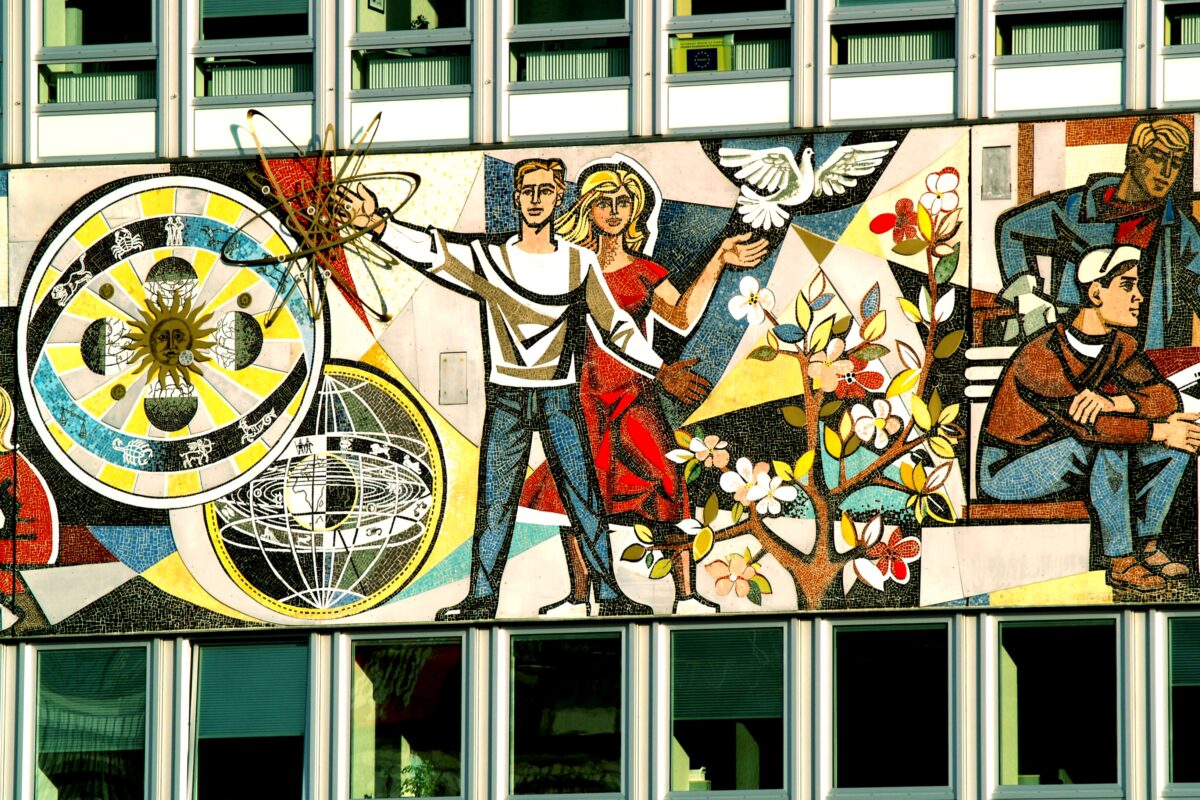
The German Democratic Republic, swallowed up by its capitalist counterpart 35 years ago, left behind a fascinating legacy. The GDR produced Superfest Glas, virtually unbreakable beer glasses; it used hyperefficient prefab concrete construction to build Marzahn, a district of 160,000 people, in just a decade; it created some spectacular architecture. And almost unimaginable for a German state, the GDR showed solidarity with Palestine and gave material support to anti-colonial movements in Africa
This was all possible because East Germany had a planned economy. Production was not organized around satisfying capital’s endless demand for profits. The GDR thus accomplished things that seem impossible today. As one small example: Cheap unbreakable glasses are incredibly useful — but they are not made today as they are not profitable.
As socialists, we defend degenerated and deformed workers states like the GDR where they still exist, such as in Cuba. We point to how a poor country like the GDR was able to solve the housing crisis with economic planning — where the much wealthier Federal Republic of Germany claims to be completely helpless.
As I argued back in September, however, while a planned economy is a necessary condition of socialism, it is not enough to define a system as socialist. Socialism refers to the transitional stage between capitalism and communism — the term only applies if the working class is taking over the management of society and the state is withering away.
A response to my piece by the Internationale Forschungsstelle DDR, mirrored at Monthly Review, insists that the GDR was socialist — yet it does not offer any definition of socialism. Surely, the comrades do not believe that it’s enough for a government to use this term — otherwise they would have to refer to the bloody neoliberal dictatorship of Bashar al-Assad as socialist too.
Democracy like oxygen
Looking to define socialism, the IFDDR implicitly concedes that democracy is necessary. As the quote, often falsely attributed to Leon Trotsky, goes: “a planned economy requires democracy just as the human body requires oxygen.” So the authors claim that the “D” in GDR was real, and East Germany was in fact democratic.
They explain that workers in the GDR had a “right to participate in factory management” and that laws were discussed by millions before passage. They even point to the notorious Eingaben system: citizens could write a letter to their representatives, and would get an answer within four weeks.
Notably, they do not mention the most elaborate form of East German democracy: GDR citizens voted for parliamentary bodies every four or five years, at the national, district, and municipal levels. Yet they only had a single list to choose from, and the National Front won between 99.95 and 99.46 percent each time. As election observers noted in 1989, despite only offering one choice, the authorities nonetheless engaged in systematic fraud.
This is not to defend parliamentary democracy, which in capitalist countries is nothing more than a façade for the dictatorship of the bourgeoisie. But a Marxist criticism of bourgeois parliaments aims for higher forms of democracy, such as workers’ councils, soviets, and Räte, in which workers elect delegates to bodies that are both executive and legislative, based on the model of the Paris Commune. East Germany’s Stalinists, in contrast, created a pathetically unconvincing copy of bourgeois democracy.
The IFDDR claims that in the GDR, “economic power was … devolved to the working masses,” yet they do not cite any examples of what economic decision making looked like. To name one major policy shift: in 1971, Erich Honecker proclaimed the “Unity of Economic and Social Policies,” which included higher subsidies for consumer goods and increased housing construction, at the expense of heavy industry.
What to do with the surplus is about the most important decision that a socialist society can make. So what percentage of East German workers were in favor of this turn? What percentage were opposed? To claim “99.46 percent” is to spit in the face of the working class. That is obviously not how real decision-making works — not in a strike committee of five workers, and not in a socialist society with 16 million citizens.
East Germany offered pseudo-democratic mechanisms that modern capitalist politicians are learning to love: “participation,” whereby decisions are made at the top, but atomized individuals are allowed to “participate” by voicing an opinion that then lands in the recycling bin.
I would say, for example, that the Federal Republic’s decades of cuts to the railway system have been terribly undemocratic because this austerity goes against the will of the majority of the population. The IFDDR might respond that everything is fine because the Deutsche Bahn provides suggestion boxes where everyone can give feedback.
Repression
While I am deliberately not focussing on the Ministry of State Security (MfS, better known as the Stasi in the West), it was also an economic decision to build up the largest security apparatus of any country that has ever existed, with 91,015 full-time employees and hundreds of thousands of informants. This bureaucracy was supposedly necessary to protect socialism and prosecute Nazi war criminals — yet it spent enormous resources surveilling workers or harassing critical communists (Rudolf Bahro and Robert Havemann are just two famous examples). The GDR’s pervasive repression against youth cultures did a lot to undermine support for socialism. And again, who decided that this was a good use of society’s resources? Why put money into suppressing Western rock bands, rather than creating better rock bands?
The authors quote Lenin, only to toss out his ideas about the withering away of the state under socialism as a “regression to the utopianism Marx and Engels criticized.” So what did Lenin write about the vast resources invested in the Stasi?
“Naturally, the exploiters are unable to suppress the people without a highly complex machine for performing this task, but the people can suppress the exploiters even with a very simple ‘machine’, almost without a ‘machine’, without a special apparatus, by the simple organization of the armed people (such as the Soviets of Workers’ and Soldiers’ Deputies…).”
In other words, a society organized on Leninist lines would rely on self-organization to defend socialism. Who, precisely, decided the GDR should do it otherwise?
John Peet
To close, I would like to quote at length from the hard-to-find autobiography of John Peet. The head of the Reuters bureau in West Berlin, Peet sought asylum in the GDR in 1950 in protest against West German rearmament. For 25 years, he published the fortnightly newsletter German Democratic Report from East Berlin. At the end of his life, looking back at 35 years in the GDR, he was proud that everyone got housing, education, and employment. He pointed to the legalization of abortion and many other accomplishments.
Yet he described the system as one of “benevolent paternalism,” in which “all important decisions” are made by the top leadership of the Socialist Unity Party. Peet commented: “I believe that many of these decisions are wise. But they are arrived at without any public discussion of the pros and cons, and without any proper channel for dissent to be registered.” (Had he not heard of Eingaben?) He concluded:
“I fear the results can only be negative. Since the majority of the population have the feeling that they cannot participate in the decision-making, they tend to withdraw and live their private lives. They march on May Day demonstrations and vote in the single-list parliamentary elections because it is the done thing, but without any particular enthusiasm. There are obviously all sorts of creeping dangers in such a conformist society; for instance, it is almost inevitably the mediocre, the conformists, who get ahead. Karl Marx once said that his favourite motto was ‘De omnibus dubitandum’ — doubt everything. Today in the GDR, the ruling motto would appear to be just the opposite: ‘Father knows best.'”
Peet spent far longer than the IFDDR defending the East German system, yet even he had to acknowledge that bureaucratic rule was preventing socialism from flourishing. We should study the GDR, which shows that a planned economy offers mind-blowing potential to improve our quality of life — but also that without real proletarian democracy, this potential can be wasted.
Red Flag is a weekly opinion column on Berlin politics that Nathaniel has been writing since 2020. After moving through different homes, it now appears at The Left Berlin.