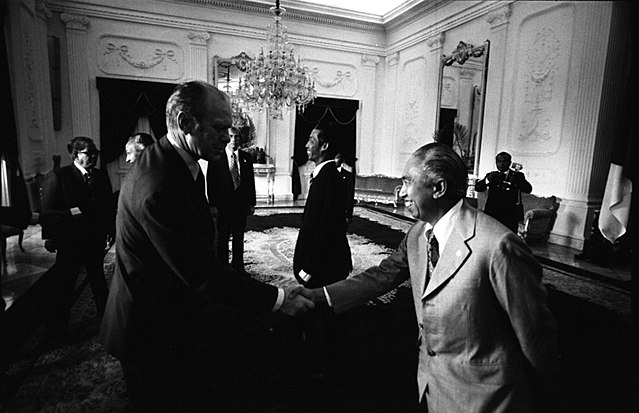
On 1st October 1965, Indonesia’s General Suharto committed what the CIA called “one of the worst mass murders of the 20th century” (see an earlier This Week in Working-Class History for more information). Backed by the CIA, Suharto seized control of the country, and the USA quickly established close military, economic, and political ties. Ten years later, Suharto’s troops invaded East Timor, half of a small island of 700,000 people located 1,000 miles south of the Philippines and 400 miles north-west of Australia.
Following the Carnation Revolution in 1974, Portugal was forced to dismantle its empire. As Portuguese forces withdrew from East Timor, elections were held and won by a coalition led by the social democratic Fretilin party (Revolutionary Front of Independent East Timor), which secured 55% of the vote in regional elections in July 1975. In response, Suharto falsely accused Fretilin of being “almost Communist”. East Timor declared independence on 28th November 1975.
Indonesia almost immediately invaded to “maintain order”. Some 200,000 people—one third of the population—were killed. On the evening before the invasion, Suharto met in Jakarta with US President Gerald Ford and Secretary of State Henry Kissinger. Despite a US law prohibiting military aid for offensive purposes, 90% of Suharto’s weaponry came from Washington. Between the invasion in 1975 and the protests that toppled Suharto in 1998, the USA supplied Indonesia with more than $1 billion in weapons.
Why did Indonesia invade? In The Specter of Genocide, historian John G. Taylor offers three main reasons: (1) East Timorese liberation might set a “negative example” for other parts of Indonesia; (2) newly discovered offshore oil deposits in the Timor Sea; and (3) the opportunity for the Indonesian armed forces to prove themselves a reliable regional ally for the USA in Asia after its defeat in Vietnam (Saigon had fallen just seven months earlier). These same factors show what was in it for US imperialism.
East Timor remains one of Western imperialism’s bloodiest genocides. Of those East Timorese who were not killed, half were imprisoned in army camps where many were raped and tortured. Indonesia’s current leader, Prabowo Subianto—sometimes called the “butcher of Timor”—is himself responsible for atrocities in the region. The country recently declared Suharto a “national hero”. We should remember the history that proves otherwise.