The Left Berlin News & Comment

This is the archive template

New study holds media to account over Palestine coverage

On Western media’s distortion of Gaza coverage and reinforcement of pro-Israel narratives


28/11/2025

A new study by Media Bias Meter, a Tech For Palestine (T4P) project, has undergone a review of over 54,000 news articles in order to analyze how Israel’s genocidal war against Palestine has been framed. The study, titled “Framing Gaza”, considered a range of factors including headline disparities, stereotyping, use of loaded language, and biases of omission, among others. Its findings portray a media landscape which distorts the public’s perception of the Gaza genocide, dehumanizes Palestinians, and allows Israeli narratives to dominate Western headlines.

Articles published between 7 October 2023 and 31 August 2025 from eight Western media outlets of various political orientations (La Libre Belgique, Le Monde, De Telegraaf, BBC News, The Globe and Mail, Corriere della Sera, Der Spiegel, and The New York Times) were collected and subjected to a linguistic analysis using a combination of computer software and human review. Media outlets were assigned a “bias score” based on an analysis of the above-mentioned factors and many other insights. The scores were later aggregated to produce a ranking, which placed The New York Times, Der Spiegel, The Globe and Mail, and the BBC as the top four most biased news outlets, surpassing outlets generally considered to be more ideologically oriented to the political right—such as De Telegraaf.

The methodology of the research team behind Media Bias Meter was primarily quantitative, collecting a large corpus of text data and analyzing keyword frequencies. This sort of data provides an excellent baseline for further qualitative analyses—contextualizing the findings with additional reports and the histories of its subjects: major news media outlets.

On the importance of media criticism

Critically analyzing the media we consume is not merely an academic adventure, but a core responsibility for those in pursuit of a democratic society—hence the importance of studies such as “Framing Gaza”. News media is often referred to as the “fourth estate”, a term which signals the importance of journalism as a social institution. Ideally, news media is able to act as a check on other institutions within society by revealing important information which may not be convenient for elites but is of vital importance to the people.

Of course, we do not live in an ideal world but in a capitalist world-system. In our world, for-profit news media prioritizes framing the news in ways which appeal to certain demographics—specifically, those (generally wealthier) demographics that advertisers are most interested in marketing to. They must maintain relationships with their sources and refrain from publishing information which might break a relationship, denying them future information which would instead be presented to their competitors—lowering their position in the capitalist rat-race.

These material realities, among others, result in various kinds of biases in reporting which are inherent and pervasive throughout major media outlets. This necessitates the active and focused development of media literacy skills on the part of the people. All kinds of news media (be they corporate, state-funded, or alternative) possess unique scopes and limitations, unique sets of bias filters which readers must be aware of. News media has a huge impact on the “common sense” of a society—the “taken-for-granted” ideas that are held to be true almost unconsciously, without any critical reflection. But by reflecting on the information we receive critically, by taking the time to subject it to intense scrutiny, readers are able to exercise what Antonio Gramsci called “good sense”.

This use of “good sense” is needed more than ever as the Western world remains apathetic at best, and outright complicit at worst, while Israel continues to commit countless war crimes against the Palestinian people. Media biases in coverage of Israel and Palestine are widely pervasive, with large corporate and state-funded media outlets systematically framing a one-sided narrative. Media critics have analyzed various tropes in Israel/Palestine coverage, ranging from word choice to whether or not international law is even mentioned when Israel violates it. Projects such as the present study by Media Bias Meter are vital to understanding how public opinion is manufactured and why it is important to hold news media to account.

Contextualizing the findings

As the study notes, “headlines shape first impressions” and, furthermore, set one’s expectations for the article they are about to read. In the age of social media, headlines take on an even greater importance as they may even be the only information a reader sees at all. When it comes to coverage of the Israeli war against Palestine, Israel has been granted dominance in the headlines of all eight of the outlets in question. The New York Times mentioned Israel a staggering 186 times for each reference it made to Palestine in its headlines. Meanwhile, the lowest ratio comes from Italy’s Corriere della Sera which still mentions Israel thrice as often in the headlines as it does Palestine.

Of course, even many of those relatively scarce mentions of “Palestine” at the top of the page were not referring to Palestine itself, but rather to pro-Palestine movements or protests. The argument has been made that editors tend to avoid naming states that are not formally recognized, and the study points to the obvious contradiction between coverage of Palestine and Taiwan by The New York Times. The same could be said for German media, as insiders at Deutsche Welle (DW) have shared internal style guide recommendations instructing staff to refer exclusively to the “Palestinian territories” rather than Palestine, but, as one insider notes, this rule is not applied to other cases (“we can say Taiwan, we can say Kosovo and the Western Sahara… there does seem to be some Palestine exceptionalism…”). While the editorial teams of Western media outlets point to the formal recognition of a state as their criteria, it might be more accurate to conclude that they are actually just reluctant to break from the “official” narratives of Western state elites.

Then there is the disparity in how these media outlets contextualize statements about Israel or about Palestine. October 7 is consistently referenced, while mentions of the 2007 blockade are relatively scarce in comparison by factors ranging from 4 (Le Monde) to 215 (Corriere della Sera). Such discrepancies mean that readers are provided with little to no historical context as they read a narrative which is told as if October 7 happened in a vacuum, ignoring the decades of oppression and violence Palestinians, particularly in Gaza, have been subjected to.

The study also looked at how often the eight media outlets repeated certain terms that are instrumentalized by Israeli narratives—“precision strikes”, “human shields”, and “self-defense”. This is important, as many media outlets have chosen to defer to official Israeli talking points rather than undergo the much harder work of upholding the basic essentials of journalistic integrity. For example, another study on German media has found that many German outlets rely mainly or in some cases solely on official Israeli sources.

From December 2024 to August 2025 a number of international organizations (including FAO, UNICEF, WFP, and WHO) repeated warnings about soaring malnutrition and the onset of famine in Gaza. The study found that despite the increasingly dire situation, terms related to “famine” and “starvation” were still used less frequently than terms related to “terrorism” across the board. Only in July 2025 did this change (and even then, not for all of the outlets considered), as the IPC published a report stating plainly that “the worst-case scenario of Famine is currently playing out in the Gaza Strip” which made the rounds through various news outlets.

The study’s findings on language use are particularly interesting when further contextualized with other reports on how the word “terrorism” has been weaponized against certain groups of people by Western media outlets. For example, a Critical Discourse Analysis by researchers publishing in the International Journal of Palestine Studies noted how lexical choices in Western media coverage humanized Israeli hostages while Palestinians are “abstracted into faceless actors or labeled ‘terrorists’, aligning with Orientalist narratives”. Evidently, the manufactured starvation of an entire people was not to be prioritized over the need to propagandize the Israeli narrative—that the “war” is a case of defending the Middle East’s “only democracy” from “terrorists”.

The failures of Western media

Media Bias Meter found a vast disparity in how news outlets discuss the “right to exist” in relation to Israel and Palestine. Der Spiegel, for example, affirmed Israel’s “right to exist” 256 times while only discussing the right for Palestinians to exist 11 times. German media in particular has been incredibly pro-Israel in its coverage, rather brashly given the fact that 73% of Germans support tighter controls over the country’s arms exports to Israel—with 30% favoring a total ban.

These data further contextualize what many now consider to be a systematic lack of journalistic integrity throughout major Western media outlets. For example, in 2024, Al Jazeera interviewed several DW workers who accused the network of having “double standards” and alleged that DW staff “openly used Islamophobic and anti-Arab slurs in the newsroom”. Similarly, in Britain, over 100 BBC staffers have accused the network of bias in its coverage of Israel’s war against Gaza, stating “Israel must be held accountable for its actions”. In the United States, the New York Times has been subject to sit-ins by protesters and boycotts by writers over its clear biases in favor of Israeli talking points. In an analysis of misinformation regarding the Israel/Palestine conflict, even Germany’s DW has now concluded that “the volume and scale of misleading content is currently greater on the pro-Israel side”.

Out of the eight media outlets which were analyzed, the study did not find a correlation between political orientation and the level of bias regarding Israel’s genocide against Palestinians. The study’s conclusion briefly speculates that the ways publications perceive the views of their respective audiences could be an explanation for this finding. While there may be something to say about how various ideological tendencies influence certain values, it would also be worthwhile to explore this point from a materialist/economic perspective.

Corporate news media is, after all, a for-profit endeavor which operates by selling a product (the audience) to a consumer (advertisers). Advertisers generally want wealthy audiences with enough disposable income to purchase their advertised products. It is therefore also important to contemplate the economic incentives of for-profit media outlets in order to maintain the types of audiences that advertisers find appealing—for example, a past analysis on coverage of the labor movement in the New York Times found that the narratives it presented became increasingly anti-labor and pro-business as the company shifted its business strategy to appeal to wealthier individuals (who, with their greater disposable income, are more appealing to advertisers).

Moreover, some €42 million have been spent by Israel in service of its Hasbara propaganda campaign, which seeks to manufacture public support through ad campaigns. For-profit media outlets may have various ideological incentives which explain their biases towards Israel, but they also have economic constraints which can be manipulated and exploited. The good news is that ideological hegemony in and of itself implies the possibility for counter-hegemonic struggles. Challenging Western media on both ideological and economic grounds is vital to replacing the hegemonic narrative with one more firmly rooted in demonstrable facts. The data derived from Media Bias Meter’s new study both reaffirms and contributes in important ways to the existing body of literature on news coverage of the Israeli war on Palestine. Most importantly, studies such as this equip activists and socially-minded individuals with the tools needed to win back terrain in the “Battle of Ideas”.
Pushing against far-Right hatred in the U-bahn 

The movements putting pressure on BVG to remove Axel Springer SE media from u-bahn screens

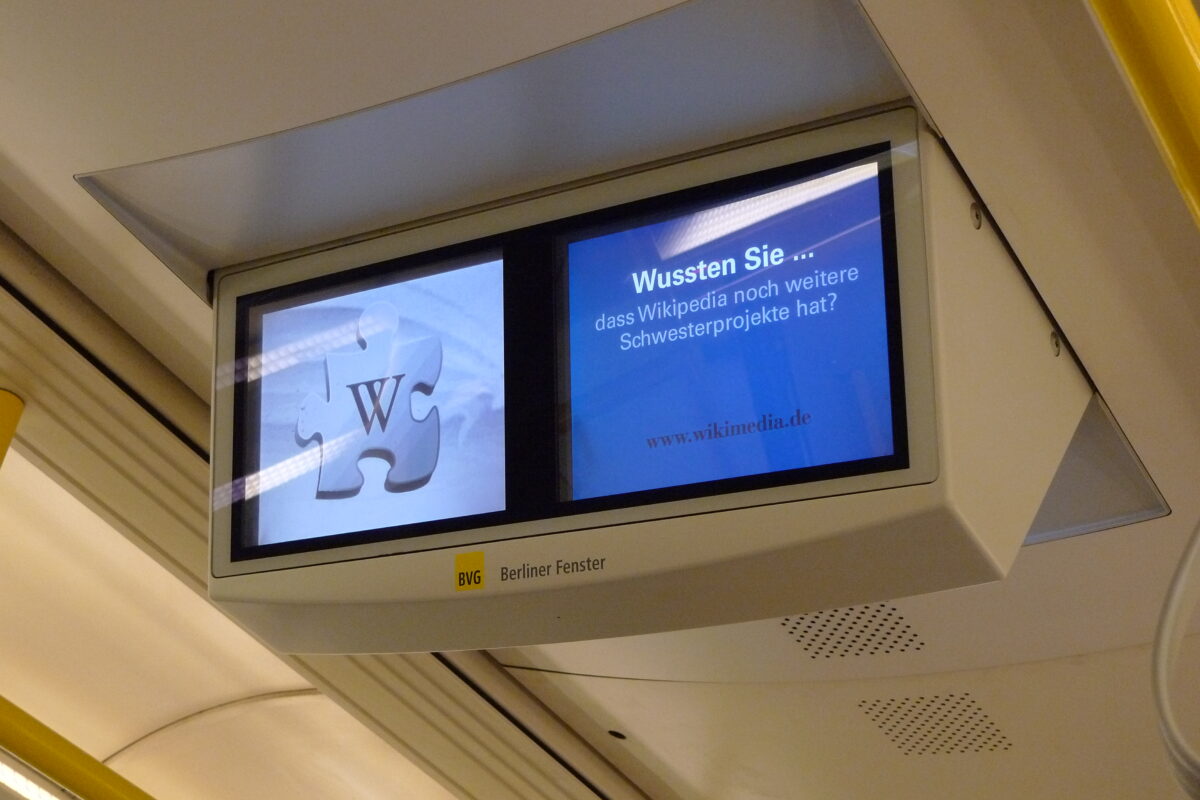
Berliner fenster screen displaying a Wikipedia fact

Have you ever paid attention to the contents of these little screens that are installed in the U-Bahn? On newer train models only upcoming stations are highlighted but older models still have the so-called “Berliner Fenster” infotainment system installed. Commuters can find useful information like weather forecasts or the occasional tiny German lesson on them, but they are also home to news articles from varying sources. Only that these “varying sources” are nearly all owned by the same right-wing news conglomerate, Axel Springer SE. 

Axel Springer SE is the same company that publishes Bild, Welt, or B.Z., essentially making money by inciting hatred against migrants, disabled people, leftists, and anyone really who doesn’t fit into their conservative agenda. After all, negative attention on marginalized groups is driving up sales and supports their antiquated power structures. These U-Bahn Screens sport headlines such as “Doping Chinese steals third place from our Swimming Queen” (German: “Doping-Chinesin klaut unserer Schwimm-Königin Bronze”) and are generally using their lever of the attention economy to push far-right talking points.

Axel Springer SE, its financial contributors, and high-ranking leaders (like Matthias Döpfner) have also repeatedly secretly or explicitly lobbied for fossil fuels, as well as neo-liberal parties such as FDP. Furthermore, they have profited off of Israel’s illegal occupation of the West Bank by selling real estate over their platform Yad2. All in all, it’s truly one of Germany’s most harmful media companies, operating on a global scale to uphold the crumbling status quo.

Though it has recently been announced that their news outlet, Welt, will be replaced by Tagesspiegel, the Berliner Fenster continues to serve as a multiplier of conservative print media in one of Europe’s most highly frequented public transportation systems. This seems especially absurd because the BVG is 1) directly financially supported by the state of Berlin and 2) officially running their PR campaign on virtues of love and open-mindedness. While they are actively trying (and struggling) to win young people from explicitly diverse backgrounds as drivers for their various understaffed train and bus lines, these same individuals are the main victims of conservative propaganda. Their livelihoods and current safety are increasingly endangered by the prominent shift towards more explicit “anti-woke” violence, fueled especially by Axel Springer media outlets and their counterparts in other parts of the world.

Not all is lost, though. Multiple groups have realized this specific issue in Berlin and have had enough of being bombarded with divisive hateful rhetoric on their U-Bahn adventures through Berlin.

The petition “Throw Springer out the window” (German: “Werft Springer aus dem Fenster”) is currently amassing pressure on this two-faced system. They are aiming to have Axel Springer content removed from all these screens, by directly putting the BVG’s self-proclaimed image of virtuosity into focus and highlighting the harsh differences between their marketing endeavours and the reality Berliners have to read every single day in the tunnels of this vibrant city.

The BVG’s official response so far has been to refer to the company “mcrud,” which is officially running the infotainment system Berliner Fenster. The petition campaign is not being deterred from this strategy of infinite delay and supposed missing decision-making power, and has rightly selected the BVG as the main target of pressure, the company desperately trying to portray itself as relatable to the common people.

Simultaneously, another campaign called “SpringerOut” (German: “SpringerRaus”) is creating viral reels on Instagram, highlighting the absurdity of supporting Springer media within this divisive political climate and providing free stickers in selected Spätis as a way for people to easily join the action. You might have already seen their designs next to the well-known (and definitely well-respected) yellow BVG stickers asking you to not drink or eat within the train. 

Pressure is rising on the BVG to not shy away from their responsibility of creating a public space free from far-right hate.

The petition has amassed over 25,000 signatures within just a few weeks and urgently needs your signature as well to continue its virality.

If this campaign is successful it could very well be a catalyst for increasing pressure against this monolith of conservative media. You can easily support the cause by adding your signature to the petition, following SpringerRaus on Instagram and of course bringing up the topic with your peers.

50 years of impunity

What has changed since the death of Spanish dictator Francisco Franco?


26/11/2025

This article is followed by an interview with Emilio Silva, president of the Association for the Recovery of Spanish Historical, which locates and identifies the victims of Francoism in mass graves. The Association’s work seeks truth, justice and reparation for the families of the disappeared.

Anti-fascist activist Nicolás Sartorius said: “Franco died in his bed, but the dictatorship died in the streets.”. Months before and after the death of dictator Franco on 20 November 1975, following 36 years of fascist military dictatorship, the people of Spain took to the streets to demand their rights. There they encountered the unpunished use of state violence typical of a fascist regime in its final throes.

The social, neighbourhood, workers’, nationalist and student movements that had been fighting for their rights and freedoms for decades during the dictatorship took to the streets during the years of the ‘transition’ after the dictator’s death. They faced the brutality of police violence and armed right-wing gangs fighting for a return to the previous regime.

In Spain, the mainstream discourse of the forces of the old Franco regime has attempted to idealise and whitewash this phase as a largely calm and peaceful period, albeit ‘tainted’ only by terrorism (particularly attributed to ETA). In this, they have been joined by  part of the democratic and left-wing forces which negotiated the conditions for the transition from dictatorship to a regime with political freedoms. But the truth is that between 1975 – the year of Franco’s death – and 1982, when the Spanish Socialist Workers’ Party (PSOE) won the parliamentary elections, there was a period of intense social struggle, first against the Franco regime and then against its laws, which still remained in force. 

This social struggle was brutally repressed by an “emerging democratic” state that refused to purge either torturing and murdering police officers or fascist judges. During those years, the old repressive apparatus, recycled as something new and democratic, killed hundreds and injured thousands of democrats. The people killed were fighting against the law on Freemasonry and communism and for freedom of thought, organisation, assembly and expression in the press and on the streets.

The workers’ movements in factories and the countryside fought for fair laws that would redistribute the profits of an elite group of Francoist landowners and capitalists who had profited from their collusion with the regime. Workers’ strikes, demonstrations and occupations spread throughout the whole of Spanish territory.

Women fought to win the rights that had been denied them for so many decades. It took women who had been controlled by the patronato de protección a la mujer (women’s protection board) 10 years after the dictator’s death to put an end to this element of repression that persecuted any woman who was somewhat free and not submissive. The continuation of this feminist struggle throughout the country has made the feminist movement in Spain one of the strongest and most socially influential in Europe.

The LGTBIQ+ rights movement fought against the law on social dangerousness, which replaced the law on vagrancy and thuggery, which persecuted and criminalised people for their sexual orientation. This law was finally abolished on 26 December 1978. However, the Spanish LGTBIQ+ movement has continued to slowly win rights by bravely confronting a significant part of society which uses Christianity to justify its backwardness and ignorance.

Students at universities and schools fought for freedom of thought and for public, secular and universal education. Public education, which for decades has allowed for a certain degree of social mobility, is now under attack by both liberal and fascist right-wing parties in Spain that represent those who refuse to accept the loss of their privileges.

The youth movement fought to lower the voting age from 21 to 18, giving the democratic forces 2 million more votes.

Neighbourhood movements fought for the right to fair housing and for the creation of social, recreational and sports centres in their neighbourhoods. These neighbourhood movements are still fully active today, confronting vulture funds and banks that are speculating on housing and evicting tenants and owners from their homes. The evictions are made possible by the help of armed fascist gangs and the police (forgive the redundancy).

National movements fought for the self-determination of their peoples and reclaimed their culture and the use of their languages, which had been banned under the Franco regime. Today, their languages are recognised as co-official languages in the Spanish state, and they continue to demand the exercise of self-determination for their peoples.

All these struggles created the political and social fabric that still endures throughout Spain today and culminated in the 15-M (Spanish Revolution) movement.

In contrast to these hard-won advances, other political reforms and laws were merely cosmetic changes that did not touch the worst aspects of the regime. The Tribunal de Orden Público (TOP), the court responsible for prosecuting political prisoners, simply changed its name to the Audiencia Nacional, and remains a symbol of what has come to be known as the ‘Regime of ’78’.

As Joan Pinyana of Memoria Libertaria – CGT states, the 1977 amnesty law, which was partly sold as something that would release anti-fascist political prisoners from the regime’s prisons and bring peace and justice, did nothing more than cement the impunity of all those who maintained the Franco regime. Judges, prosecutors, police officers, military personnel, prison guards, ministers and the rest of the state administration officials who maintained Franco’s regime of terror were exonerated from all the crimes they had committed with the stroke of a pen, and most of them remained in their jobs.

As a result, and despite the two historical memory laws passed by the Spanish state (in 2007 and 2022), we continue to have Francoist symbols and streets named after coup leaders throughout the country. Meanwhile, notorious torturers have gone unpunished, mass graves are still being opened and the remains of the disappeared exhumed by civil organisations. An unknown number of our dead are still buried in ditches.

“Against Fascism Workers Self-defence ” Liga Comunista Revolucionaria (now Anticapitalistas) Madrid 1. May. 1979. Photo: Txemi Martínez

Interview with Emilio Silva, president of the Association for the Recovery of Spanish Historical Memory

50 years after the death of dictator Francisco Franco, there are still Francoist symbols and streets named after fascist military figures. What are the obstacles to removing these symbols and names?

Regarding the symbols, I would say that there is no obstacle to removing them. What there is, is a great lack of political will. This is represented by the fact that 1,300 metres from the official residence of all the presidents of the Spanish government from 1977 to the present day, there is a large victory arch celebrating the victory of Franco, Hitler and Mussolini – the three armies that paraded through Madrid on 1 May 1939. That arch has been illegal since the Memory Law banned it in December 2007, but all the ministers and presidents of Spain since then have passed through it. No one has wanted to comply with the law. 

However, 17 years ago, in this same city, the Carabanchel prison, which was one of the great centres of repression of the dictatorship, was demolished. Carabanchel was infinitely larger than the arch, so there was no problem in making the arch disappear. It must be that politically the arch is much larger than the cells of that prison.

Your association has participated in multiple exhumations. How many mass graves are estimated to still remain in Spain? And what have the different governments done about it?

Well, it is very difficult to know how many graves remain in Spain because we do not have the data. The government is working with a figure of around 10,000 people still to be exhumed, but we do not know the source and we are not given the technical details of that investigation. Spain is the only country in the world in which people have disappeared due to political violence and the state has to award grants to associations to search for them [interviewer’s note: instead of having a dedicated state-led institute]. 

It is regrettable that the government does not allow the families this right. It does not take care of them. In fact, we have just learned from a video that Pedro Sánchez’s government has exhumed 9,000 people and only 70 of them have been genetically identified. This is part of the lack of attention shown to the families. 

As an association, we began the search for the disappeared because a family asked us to. It should be shameful for the government that an association like ours, which does not receive a penny of public aid, because it does not want it, has identified more disappeared persons in the last six years than the Spanish government.

For decades, Spanish schools have taught that Franco’s dictatorship was not a dictatorship – that word was always avoided. What issues remain unresolved in Spanish education?

In many school books and school programmes, Franco’s dictatorship was aseptically referred to as “the Franco era”. But it is not only a question of language, of not calling it a dictatorship. Until six years ago, textbooks were not required to say that the coup d’état of 1936 had been a coup d’état. There was a political will to generate ignorance among young people, to hide the crimes of the dictatorship, to avoid creating new witnesses and new citizens who knew about that past. 

Fundamentally, this was because the Spanish elites, who have their origins in the political and economic corruption of Franco’s dictatorship, carried out a major whitewashing of their participation in Francoism and wanted to use this whitewashing to achieve democracy. To do this, they needed a lot of help from the media, educational policies and parliamentary silence.

Which are the main Spanish companies that benefited from the dictatorship and are still active today?

There are quite a few Spanish construction companies, such as Fomento de Construcciones y Contratas and Ferrovial, that grew under the protection of Francoism, but for me there is one paradigmatic case, which is Naturgy. Naturgy is one of the largest energy companies in Spain and was born out of the murder of a Galician Republican MP named José Miñones. Miñones was a progressive man and owner of the main electricity company in Galicia. After he was assassinated by the fascists in December 1936, a friend of Franco’s, Barrié de la Maza, took over the company at gunpoint, changed its name to Unión Fenosa. Today it is called Naturgy

In another country, Naturgy might have to pay compensation to the family of the original owner’s descendants and hold some kind of public event to acknowledge that it was born at gunpoint. This is an example of how the Spanish economic structure is linked to the dictatorship. 

About four weeks ago, a report was released stating that only 26% of Spanish millionaires are so because of their own initiative, which means that 74% inherited their wealth. Within that 74% there is a very high percentage of people who have inherited businesses that were created or strengthened by the corruption of the Franco regime.

Nazi concentration camps are well known. Much less well known are the concentration camps of other fascist regimes, such as Franco’s. It is estimated that there were some 300 camps between 1936 and 1947. What was their main function and have there been any reparations for the victims of these camps?

We now know that there were more than 300 concentration camps, mainly thanks to the research of a journalist, Carlos Hernández. Years ago, I visited some of them with prisoners who had been interned there, such as Félix Padín, an anarchist who was in the Miranda concentration camp. 

We can say that they were not biological extermination camps, but rather civil and political extermination camps. The aim was to educate those who had opposed the coup – the people who had taken up arms against fascism before any other people in Europe. The aim was to instill enough fear in them so that they would work to rebuild the country and be the labour force of the victors. 

In some, such as Miranda Castuera or Puerto de Santa María in Cádiz, atrocities and murders were committed. In Castuera in particular, they used the Indian rope, tying two groups of prisoners together with a rope, the larger group in front and the smaller group behind, then throwing the front group down a mine shaft, which ended up dragging those tied behind them. 

The aim was to terrorise that part of the population that had, let’s say, political awareness and political participation in order to design a society where certain behaviours had been exterminated and obedience through fear was the norm throughout society.

Red Flag: Nation states belong to the bourgeoisie

In his weekly column, Nathaniel Flakin looks at a socialist answer to national oppression.

Nation states belong to the bourgeoisie

For the last two years, the global Left has been mobilizing against national oppression. In Gaza, we are witnessing the horrific results when the imperialist powers and their local vassals attempt to deny the right to self-determination. Every people has a basic democratic right to live free of foreign domination.

Yet what is our goal as leftists? The world might seem like it is made up of a certain number of nations, with justice requiring that each nation has its own state. We do indeed fight for independent homelands for the Palestinians, the Kurds, the Sahrawis, etc.

Yet bourgeois society tends to project nations back into the ancient past, as if they were natural phenomena that have always existed and will always exist. The German bourgeoisie will talk about “Hermann the German” fighting against the Romans in AD 9, as if inhabitants of the Roman province of Germania had anything in common with Deutschland

Products of the Capitalist Era

Nations are actually a product of the capitalist era, and their myths—like Hermann—were created in the 19th century. Before that, cultures tended to be local, with no media or schools working to ensure that the population of a given territory spoke the same language as its rulers. Nation states emerged at the end of the feudal era, when the new capitalist system required large markets. In Germany, for example, upwards of 300 principalities—each with their own borders and customs duties—were replaced with a single national market, allowing capitalist firms to expand enormously.

The formation of nation states, far from being natural, entailed extreme violence, wars, and ethnic cleansing. “Germany” might appear like a self-evident category today. But who decided that Bavaria would be a component part and Austria would not? This was a product of intrigues by emperors and diplomats, and not of popular will. A few coincidences could have turned Prussia into a separate nation with a separate culture from Germany, or Denmark into a German province with a strange dialect. 

In 1913, Joseph Stalin attempted a Marxist definition of a nation:

A nation is a historically constituted, stable community of people, formed on the basis of a common language, territory, economic life, and psychological make-up manifested in a common culture.

(It might seem strange for me to quote Stalin, who is known as the head of a chauvinist bureaucracy in the Soviet Union that ruthlessly suppressed national self-determination. Yet before the First World War, he defended the Bolsheviks’ internationalist principles that he later betrayed. This pamphlet, ghostwritten by Nikolai Bukharin, is actually quite good.)

Stalin emphasized the historic character of nations: each “has its history, its beginning and end.”

Lenin and Self-Determination

More than any other socialist, Lenin stood for fusing the working-class struggle for socialism with the struggles of oppressed peoples against imperialism. Yet Lenin made no concessions to nationalist ideology:

Marxism cannot be reconciled with nationalism, be it even of the “most just”, “purest”, most refined and civilised brand. In place of all forms of nationalism Marxism advances internationalism, the amalgamation of all nations in the higher unity, a unity that is growing before our eyes…

Nation states represented progress when they were replacing feudal patchworks with large national communities with some sense of common purpose—yet these were always states led by the bourgeoisie, and thus always marked by some degree of expansionism, colonialism, and genocide. Creating a national community means excluding someone. As we see today, the German Staatsvolk is not simply given, but pruned with racist ideology and brutal deportations.

In any case, nation states have long outlived their usefulness: capitalism has distributed production around the globe, and dividing humanity along fairly arbitrary borders is a hindrance. 1914 represented the turning point, when the destructive side of nation states came to the fore. As Leon Trotsky wrote in 1934: 

The national state with its borders, passports, monetary system, customs and the army for the protection of customs has become a frightful impediment to the economic and cultural development of humanity. The task of the proletariat is not the defence of the national state but its complete and final liquidation.

In place of nation states, socialists advocate a world socialist republic—which would only represent a transition toward a classless society with no need for a state of any kind, not even a democratic one.

More than Self-Determination

While we fight for self-determination of oppressed peoples, without any conditions, we need to embed that in a larger strategy for socialism. Our goal is a free Palestine—but would a Palestinian nation state, after the dismantling of Zionism, actually be free? Most people in the Middle East do not live under direct colonial occupation. But we see how bourgeois forces—the leaders of their respective nations—continue to exploit and oppress the people in the interest of imperialism.

As long as capitalism exists, formally independent nation states will remain under imperialist and neocolonial dominance. No amount of “international law” will overcome this fundamental inequality. So a free, bourgeois Palestine would still be oppressive for most Palestinians.

True freedom, true self-determination, means that workers, peasants, and poor people must be able to determine their own destiny. This requires not only kicking out imperialism and its vassals, but also toppling the “national” bourgeoisie—the rulers of the nation. Once the working class is in power in any country, workers have no interest in sealing off “national” cultures against the workers of other territories.

In place of narrow nationalisms, socialism will see global collaboration of working people, so that culture becomes infinitely more free and varied, and is not tied to any particular border. When we say “Free Palestine,” our goal is this kind of universal human liberation.

Red Flag is a weekly opinion column on Berlin politics that Nathaniel has been writing since 2020. After moving through different homes, it now appears at The Left Berlin.

News from Berlin and Germany, 26th November 2025

Weekly news round-up from Berlin and Germany

NEWS FROM BERLIN

Bundeswehr trained in Berlin U-Bahn

The guards battalion of the Federal Department of Defence used the U-Bahn station Jungfernheide for a training exercise between November 17 and 21, as announced by the Bundeswehr. The special battalion is responsible for protecting the government buildings in an emergency. Exercises took place on Monday, Tuesday and Wednesday night from last week between 1am and 4am. No live ammunition was used during the training exercise. Further training took place at the so-called “Fighting City” training ground for police in the district of Ruhleben, where soldiers were trained in searching buildings, how to detain enemy forces and defend infrastructure. Source: iamexpat

Black-red Olympic project in Berlin falters

According to a representative survey commissioned by the “Tagesspiegel”, 67% of those surveyed reject a bid for 2036, 2040, or 2044. For the state government, which sees the Olympics as an opportunity for infrastructure, sports, and urban development, this is a clear dampener on the mood. The “NOlympia” alliance has already announced a referendum, which is scheduled to start on January 1, 2026. That is because a possible vote by Berliners would probably not take place until 2027 at the earliest. It would be too late to influence the decision of the German Olympic Sports Confederation (DOSB). Source: berliner Zeitung

Wage dispute at Berlin’s Brammibal’s Doughnuts

A wage dispute has arisen between vegan doughnut bakery Brammibal’s and the Food, Beverages, and Catering Union (NGG). The NGG accuses Brammibal’s of responding to wage demands with benefit cuts and the introduction of a fast food collective agreement. “This legally prevents further strikes, while most employees will continue to earn barely above minimum wage in the future,” the NGG said. Source: berliner Zeitung

NEWS FROM GERMANY

Over a million people in Germany are now homeless

On November 17, the Federal Working Group on Homelessness Assistance (BAG W) published new projections for homelessness in Germany in 2024. According to the working group, 1,029,000 people were affected over the course of last year. The number has exceeded the million mark for the first time. It also represents an increase of 11% compared to the previous year. The new figures also show how high the proportion of refugees affected by homelessness is: around 80% did not have German citizenship in 2024, while 20% were German citizens. Sahra Mirow (“die Linke”), observes that “homelessness is not an individual failure, but an expression of anti-social policies.” Source: taz

“Airline prices won’t drop a single cent as a result”

German cities are expected to become more competitive in international air travel. That, at least, is the goal of the German government with its planned reduction of the air traffic tax (starting July 2026), which was only increased in 2024. The reduction in the air traffic tax is now expected to relieve the industry of around 350 million euros annually. Mobility researcher Weert Canzler from the Berlin Social Science Center (WZB) criticizes the reduction of the air passenger duty as a “fatal signal.” “The federal government is sending the message they don’t care about climate protection.” Source: rbb

German Interior Minister: “My migration course is tough”

Germany’s Federal Interior Minister Alexander Dobrindt (CSU) said in an interview with Deutsche Welle he had not overpromised when he announced stricter migration policies. “My course is very tough, and that’s exactly how it’s been perceived,” he affirmed, adding still that “from day one, we took the decisions needed to make sure that border controls are tightened.” Dobrindt considers yet the 60% drop in the number of initial asylum applications in Germany to be “clear evidence that illegal migration is declining significantly.” Meanwhile, critics call the term “illegal migration” dehumanizing and misleading. Source: dw

2026: German economy expected to grow

According to the European Commission’s autumn forecast, Germany’s gross domestic product (GDP) will grow by 1.2% in 2026. The German government also predicts 1.4% growth in 2027. “A substantial part of growth in the coming years will be a result of higher state financing, in particular from the special funds for infrastructural investments and increased investment in defence,” Federal Economics Minister Katherina Reiche (CDU) said in a government statement in October. While the German economy is on the mend, GDP growth rates forecast for the federal republic in 2026 are still below the average estimate for the political bloc, of 1.4% for next year. Source: iamexpat

Guests leave the hall during Merz’s speech

In protest against the CDU Chancellor Friedrich Merz’s “cityscape” remarks, around 30 people left the hall before he held a speech on integration. At the event, athletes who are committed to the topic of sport and social cohesion were honored with the Talisman Award. They wore stickers with the inscription “We are the cityscape” and only returned to their seats after the approximately 20-minute speech. “Germany is a country of immigration,” the Chancellor emphasized. At the same time, Merz also made it clear that immigration must be managed and controlled. Source: taz

How to tear down the firewall

“The Firewall Only Benefits the AfD”—under this title, political scientist Philipp Manow elaborated on the idea of a minority government in “Stern” that seeks shifting majorities—including with the help of the AfD. Jürgen Kaube followed up in the FAZ, and Claudius Seidl in the Süddeutsche Zeitung. All three believe the firewall must be removed. Within the CDU, one who advocates for opening to the AfD is the historian Andreas Rödder. He believes that easing the firewall might force the AfD to decide whether it wants to move into a democratic state or not. What is true is that the CDU has so far found no way to contain the AfD. Source: taz

Federal Constitutional Court sets limits on deportations

With the assistance of the non-profit organization Society for Civil Rights and the human rights organization Pro Asyl, a Guinean man appealed to Germany’s highest court in Karlsruhe, and the court there has now assessed the case differently than the Higher Administrative Court of Berlin-Brandenburg. The plaintiff’s asylum application in Germany had been rejected, and he was scheduled for deportation in 2019. Police arrived then at the accommodation in Berlin where he shared a room with another man. Without a warrant, the police then forced the door open. The Federal Constitutional Court in Karlsruhe ruled that this action violated the Guinean man’s fundamental right to the inviolability of his home. Source: dw