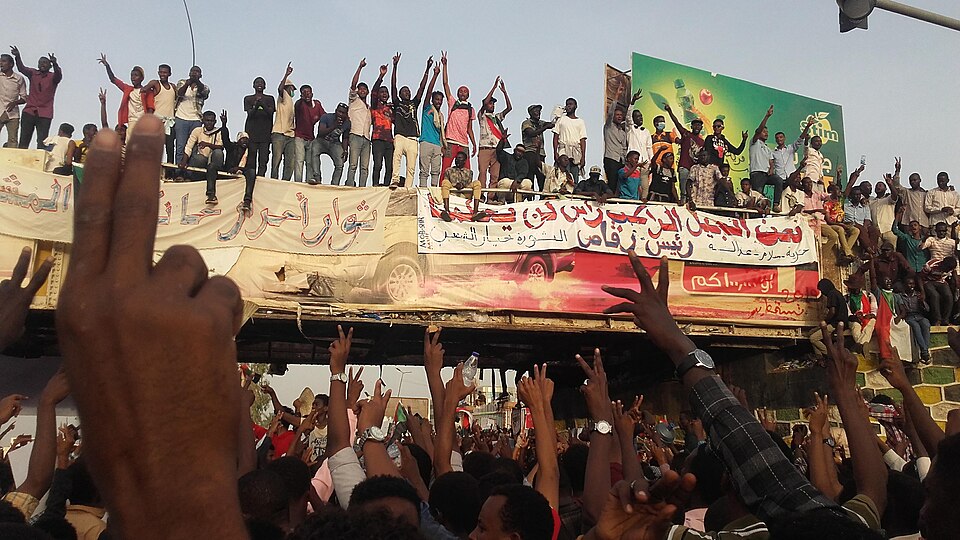
On 19 December 2018, the Sudanese government announced that the price of a loaf of bread would triple, from one Sudanese pound to three. Similar price rises followed for other basic goods, on the recommendation of the IMF. The subsequent protests were not merely economic, but a revolt against the 30-year rule of the dictator Omar al-Bashir. In Atbara—a marginal town but historically a centre of militant rail workers—protesters burned down the offices of Bashir’s National Congress Party.
The Atbara protests quickly spread to several cities, including the capital, Khartoum. The main organising force was the Sudanese Professionals Association (SPA), a coalition of members from 17 banned trade unions, including teachers, doctors, engineers, pharmacists and other white-collar workers. The SPA was supported by youth and women’s organisations. On 25 December, it mobilised thousands for a march on the presidential palace in Khartoum. The march was met with tear gas, rubber bullets and live ammunition.
In April 2019, protesters began an indefinite sit-in around military headquarters. On 11 April, Bashir was removed from power. The army dissolved parliament and attempted to retain control, announcing that a Transitional Military Council would rule during a so-called “transitional” period. Protesters again took to the streets, forcing the council’s leader, Awad Ibn Auf, to resign. The movement continued, culminating in a general strike on 28–29 May, followed by another strike two weeks later.
On 3 June, in what became known as the Khartoum massacre, government forces killed over 100 protesters at the sit-in in Khartoum, raped men and women, and threw dozens of bodies into the River Nile. Yet the protests persisted. In August, opposition leaders negotiated a rotten power-sharing agreement with the military council. On 25 October 2021, a military coup dissolved the transitional government and abducted civilian ministers and revolutionary leaders.
The success of the counter-revolution led to war between the Rapid Support Forces—successors to Bashir-backed Janjaweed militias—and the Russian-backed Sudanese Armed Forces. Neither faction represents the revolutionary moment of 2018. That legacy survives instead in the neighbourhood-based resistance committees that emerged after a split within the SPA. Initially organising mutual aid during Covid, these committees are now developing an independent political programme. The Sudanese revolution is not over.